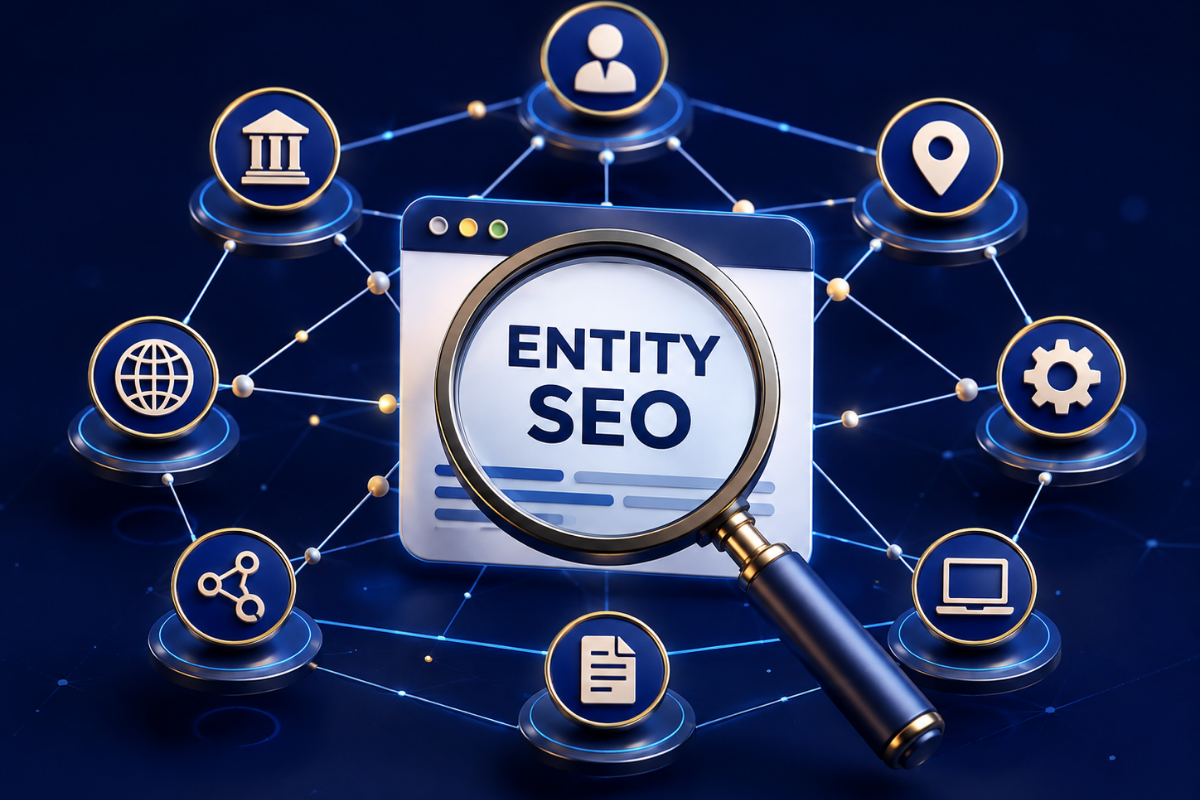
Entity SEO is an SEO approach that focuses on search engines evaluating a web page not only through the keywords used, but also through people, brands, products, organizations, places, concepts, and the meaningful relationships between them. Therefore, the goal is not merely to rank for a specific word, but to help the search engine accurately understand which entities the content is related to.
For example, if the term "Apple" is taken as a standalone keyword, it could refer to a fruit, a technology company, or a different concept. For the search engine to determine the correct meaning here, it needs to evaluate the context in which the word appears, related concepts, and its connections to other entities. This distinction lies at the heart of the question: what is a Google entity? An entity is a real or conceptual existence that can be uniquely identified, such as a specific person, place, object, organization, or abstract concept.
In the Entity SEO approach, content clearly reveals the relationship between the entities that form the topic, rather than repeatedly constructing sentences around a single keyword. In this respect, entity-based SEO is evaluated within the same ecosystem as technologies such as semantic search, Knowledge Graph, structured data, natural language processing, and machine learning.
Why does Entity SEO require a different perspective?
In traditional SEO, keyword research, search volume, competition level, and on-page optimization continue to be important elements. However, simply having the target keyword in a piece of content does not mean that the search engine will understand the topic in its full context.
Entity SEO strategies come into play here. The main topic of the content is determined; then, meaningful connections can be established between this topic and directly related sub-entities, concepts, people, organizations, technologies, and user intents. Research data also defines one of the main goals of Entity SEO as understanding how search engines process entities and making this structure applicable to websites.
This approach also strengthens the connection between Entity SEO and content optimization. Content does not become entity-focused merely by using the phrase "Entity SEO." The relationships that the content establishes with Google Knowledge Graph, Schema.org, Semantic Web, Search Intent, Topical Authority, and other related concepts can also contribute to the understanding of the topic. In the research set, these concepts are among the main and related entities of Entity SEO.
What is the purpose of Entity SEO?
The short answer to the question what is the purpose of Entity SEO is: It helps search engines understand more clearly which entities, topics, and relationships a piece of content is built around.
In this system, the question "which word was used?" is not the only important one. Questions like "What entity does this word refer to?", "With which concepts is this entity related?", "What user need does the content address?", and "How do other reliable sources on the web define this entity?" also gain importance.
Therefore, entity-based search engine optimization should be considered not as an alternative to keyword optimization, but as an approach that expands it into a broader semantic framework.
Short answer: Entity SEO is an SEO approach that helps search engines go beyond the words on a page to understand entities such as people, brands, products, organizations, and concepts, as well as the relationships between them.
How does Entity SEO work?
To understand how Entity SEO works, one must distinguish between "word" and "entity." A word can be used in different meanings; an entity, however, refers to a specific person, organization, place, object, or concept. Search engines try to determine the intended meaning by evaluating the context in which the word appears and other concepts surrounding it.
For example, it is not possible to understand whether the word "Jaguar" refers to a car brand or an animal species by merely looking at the word itself. Concepts on the page such as "automobile," "SUV," "engine," "sales" create semantic relationships pointing to the brand; concepts like "forest," "predator," "mammal" point to the animal.
At this point, the question what is an SEO entity becomes clearer: From an SEO perspective, an entity is a person, brand, product, organization, place, event, or concept that the search engine can associate with a specific meaning.
The difference between entity and keyword
A keyword is a word or phrase that a user types into a search box or that is targeted on a page. An entity, on the other hand, is the real or conceptual existence that the word represents.
Keyword-focused approach | Entity-focused approach |
|---|---|
Focuses on word usage | Focuses on entity and meaning relationships |
Centers on the search query | Centers on the topic and context |
Examines keyword variations | Examines related entities |
Prioritizes on-page optimization | Considers content, structure, and links together |
Asks the question: "Which keyword should I target?" | Asks the question: "Which entities and relationships should I explain?" |
This distinction also forms the main point regarding the difference between Semantic SEO and Entity SEO. While Semantic SEO focuses on strengthening the meaning, context, and topical coverage of content, Entity SEO aims to express specific entities within this semantic structure and their relationships more clearly.
What is Knowledge Graph?
Knowledge Graph is an information graph approach that enables structured representation of entities and the relationships between them. Google's effort to understand entities and associated information within its search systems is one of the most important parts of Entity SEO.
A person, company, product, or place can be considered not in isolation but also through its relationships with other entities.
For example, for a company:
Company → founder → person
Company → headquarters → city
Company → industry → technology
Company → product → software
a network of relationships can be envisioned.
This structure is important for Knowledge Graph entity SEO. Because the topic moves beyond merely the presence of a specific word on a page to how the entity is related to other information.
In research data, Google Knowledge Graph, Semantic Web, Schema.org, Vector Search / Embeddings, Wikidata / Wikipedia, and NLP are shown as the main core entities of Entity SEO.
Why are entity connections important for SEO?
The clearer the relationships between the entities in a content are established, the more context the page's topic gains. The goal here is not to unnecessarily repeat the same concepts, but to connect truly relevant information in a natural structure.
For example, in comprehensive content prepared about "Entity SEO," instead of just repeating the phrase "Entity SEO," the relationships between the following concepts can be explained:
Entity SEO → semantic search → Knowledge Graph → structured data → Schema.org → Search Intent → Topical Authority
This kind of SEO conceptual linking helps the reader understand the topic more easily while also broadening the content's scope.
The relationship between Entity SEO and Semantic SEO
The shortest answer to the question what is Semantic SEO is an optimization approach that helps the search engine evaluate not only keyword matching but also the meaning and context of a query and content.
Entity SEO is one of the important parts of this structure. Because within the semantic structure, people, brands, products, organizations, and concepts play specific roles.
Therefore, Entity SEO and Semantic SEO should not be considered as two completely independent areas of work. While Semantic SEO expands the meaning and context of a topic, Entity SEO focuses on making the entities within this structure more prominent.
How does Google recognize an entity?
Google's understanding of an entity cannot be explained by relying on a single signal. Research data suggests evaluating Knowledge Graph, structured data, Wikidata, Wikipedia, natural language processing, machine learning, and the relationships between entities for Entity SEO.
Therefore, when performing SEO entity optimization on a website, it is necessary to create a consistent whole rather than relying on a single technical application.
If the brand name is written differently on different pages, organizational information conflicts, author profiles are ambiguous, or connections are not established between the entities described in the content, it may become difficult for the search engine to interpret the meaning on the page correctly.
What does Schema markup mean for Entity SEO?
Structured data allows information on a page to be marked according to specific standards for easier machine understanding. Schema.org is one of the fundamental standards in this area.
In Schema markup Entity SEO efforts, appropriate schema types such as Organization, Person, Product, Article, LocalBusiness, and similar, can be used. However, simply adding more schema to a page does not automatically create a stronger entity structure. The marked data must be consistent with the information actually present on the page and presented to the user.
In the Entity SEO research set, Schema.org, structured data, and Author / Organization entities are discussed in connection with E-E-A-T.
Entity SEO and authority relationship
A website's ability to build authority on a specific topic cannot be explained solely by publishing a large number of content pieces. How well the content masters the topic, how the author's expertise is demonstrated, how consistent the organization or brand information is, and how it is linked to reliable sources are also important.
The connection between Entity SEO and authority emerges here.
From an E-E-A-T perspective, accurately defining entities like authors and organizations can help make expertise visible. Research data also considers Person and Organization Schema structures among the elements that support author and platform authority.
How is Entity SEO done?
It is more appropriate to approach the question how is Entity SEO done through an actionable sequence of steps:
Determine the main topic and core entity.
Extract sub-entities directly related to the topic.
Map the relationships between entities.
Determine the user's search intents.
Structure the content not only by keyword but by topical scope.
Use structured data on appropriate pages.
Make author, brand, and organization information consistent.
Establish necessary links with reliable external sources.
Link relevant content within the site to each other.
Check if the content directly answers the user's question.
In this process, Entity SEO techniques cover multiple areas, from content production to technical SEO. Research data specifically mentions "Entity Mapping," Wikidata and Google Knowledge Graph querying, N-gram, Vector Search / Embeddings, and E-E-A-T connection as application areas that can fill gaps in competitor content.
How is entity mapping done?
Entity mapping is the process of identifying the main entity at the center of a content piece and systematically extracting its related sub-entities.
For example, if the main entity is "Entity SEO":
Main Entity | Related Entity | Relationship |
Entity SEO | Google Knowledge Graph | Understanding entities |
Entity SEO | Structured data | |
Entity SEO | Semantic SEO | Semantic context |
Entity SEO | Search Intent | User purpose |
Entity SEO | Topical Authority | Topical coverage |
Entity SEO | E-E-A-T | Expertise and trust |
Entity SEO | NLP | Language and meaning analysis |
Entity SEO | Vector Search | Semantic similarity |
This table illustrates the basic logic of SEO entity extraction. When the main entity and related entities are extracted before content preparation, deficiencies in topical coverage are more easily noticed.
How to create Entity SEO examples?
When discussing the topic of "coffee," instead of just repeating the word "coffee," one can address truly related entities such as coffee beans, Arabica, Robusta, roasting, grinding, espresso, filter coffee, caffeine, and brewing methods.
Similarly, in content about a "phone," sub-entities like brand, model, operating system, processor, screen, camera, battery, and connection technologies can be explained within a natural context.
The fundamental principle here, when producing Entity SEO examples, is not to add off-topic concepts to the text merely for SEO purposes. The relationship must be real, meaningful, and beneficial to the reader.
Entity SEO tools and analysis process
Entity SEO tools can be used at different stages of entity research and content analysis. Research data highlights areas such as Knowledge Graph queries, Wikidata, Wikipedia, NLP, N-gram, and Vector Search / Embeddings.
When choosing tools, instead of focusing solely on systems that generate reports, one should consider how the obtained data can be transformed into a content strategy.
During an SEO entity analysis, the following questions can be asked:
Is the main entity correctly defined?
Are the related entities sufficient?
Is there a significant sub-topic missing from the content?
Are the relationships between entities clear?
Is the user's search intent being met?
Is the author and organization information consistent?
Does the structured data represent the actual information on the page?
Do internal links support the topic cluster?
Evaluating these questions together creates a broader Entity SEO optimization perspective than simply measuring keyword density.
Common mistakes in Entity SEO work
The goal of the entity approach is not to stuff as many concepts as possible onto a page. Adding irrelevant entities merely to attract search engines' attention can harm the user experience of the content.
Another mistake is to view structured data as the entirety of Entity SEO. Schema markup is only one part of a broader entity strategy.
Aiming solely for a Knowledge Panel to appear on Google is also not the correct approach. Whether a brand or person is in the Knowledge Graph is not the same as a web page being high quality, useful, and accurate.
Entity SEO work should be conducted by evaluating content quality, topical coverage, entity relationships, technical structure, reliable sources, and user intent together.
Key concepts to learn for Entity SEO training
For someone seeking Entity SEO training, merely learning SEO tools is not enough. The following fundamental concepts must be understood together:
Entity and entity disambiguation
Semantic Web
Knowledge Graph
Schema.org and structured data
NLP
Search Intent
Topical Authority
E-E-A-T
Entity Mapping
Vector Search and Embeddings
Internal linking structure
Content clusters
Research data also indicates that these concepts form the fundamental knowledge areas of Entity SEO.
Interpreting Entity SEO as merely "using entities instead of keywords" falls short. The real change is the shift of SEO work from a keyword-centric structure to a broader structure centered on meaning, context, entities, and relationships.
Entity SEO's place in the search experience
Entity SEO should not be considered merely as an optimization approach targeting classic search results. The increasing naturalness with which users ask questions and the widespread adoption of AI-powered search experiences make the establishment of clear and consistent conceptual relationships in content even more valuable.
Research data suggests that systems like Perplexity, SearchGPT, and Google AI Overviews can benefit from an entity structure in terms of GEO and AEO; it is recommended to use short definitions in a direct answer format and subheadings in question form.

Recep Bayoğlu
SEO Team Leader
If you want to talk more about this topic or need a tailored solution for your brand, you can reach me directly.
Our Services
Related Services
Google Ads Management
Top pickUse your ad budget most efficiently with professional Google Ads management.
Meta (Facebook & Instagram)
Reach your target audience with Facebook and Instagram ads.
SEO Consulting
Rank higher in search engines and grow organic traffic.
GEO Consulting
Get cited as a source inside ChatGPT, Gemini and Perplexity answers.
Social Media Management
Strengthen your online presence with professional social media management.
E-Commerce Solutions
T-Soft, İkas, Ticimax and İdeasoft infrastructures.
TikTok Ads
Reach young audiences with TikTok ads.
Video Production
Professional 4K video production services.
Web Design
Modern user-friendly web design.
Yandex Ads Management
Reach Russian and CIS markets with Yandex ads.
Telegram Ads Management
Reach audiences directly with Telegram sponsored messages.
ChatGPT Ads Consulting
Position your brand in the in-chat advertising ecosystem.
Gemini Ads Consulting
Gain an early advantage in Google AI Mode ads.
T-Soft E-Commerce Site
T-Soft infrastructure for enterprise scale.
İdeasoft E-Commerce Site
Flexible and powerful e-commerce infrastructure.
İkas E-Commerce Site
Fast setup, modern e-commerce infrastructure.
Ticimax E-Commerce Site
Scalable e-commerce solution.
More from this category

digitalup What Is Zero-Click Search?

digitalup What is Programmatic SEO (pSEO)? A Guide to Scalable Traffic with Thousands of Pages

digitalup What is SEO? The Evolution of Search Engine Optimization in 2027 and Beyond