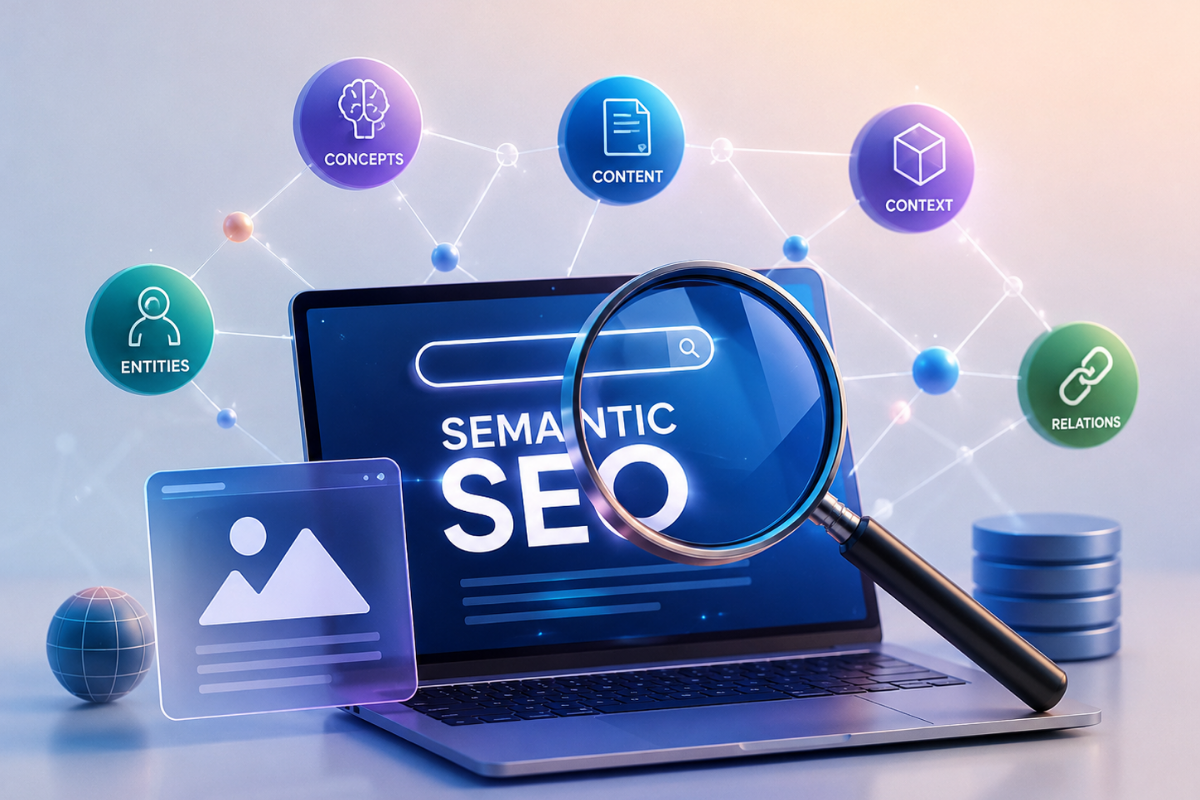
The days when search engine optimization solely focused on keywords are long gone. In today's digital ecosystem, search engines go beyond the words in texts, analyzing the meaning, context, and user intent behind the information. This is where the question, **what is semantic SEO**, comes into play, becoming central to websites' strategies for gaining organic visibility. Semantic SEO is the process of optimizing your content not just with specific phrases, but within the framework of topical integrity and conceptual relationships.
In 2026, as search habits evolve towards AI answer systems (AI Overview) and generative engine optimization (**GEO**), it has become more critical than ever for your content to be correctly understood by search engines. Google uses deep learning and natural language processing (NLP) technologies to understand what users are searching for and how well the provided content meets that need. In this guide, we will examine all the semantic SEO techniques you need to know, step by step, to elevate your search performance to next-generation standards.
What is Semantic SEO?
**Semantic SEO** is a holistic search engine optimization approach that optimizes content not just through individual keywords, but through the relationships between topics, context, **search intent**, and entities.
**Summary**
**What is Semantic SEO?** Semantic SEO is a modern SEO methodology that focuses on the meaning context of words, the relationships between concepts, and user intent to enable search engines to understand the content of a page just like a human.
In the traditional SEO approach, the goal was merely to repeat a specific keyword a certain number of times within the text. However, to provide a modern answer to the question **what is semantic SEO**; this approach requires addressing a topic with all its sub-headings, related concepts, and potential questions a user might have during their search journey.
What is Semantic Search and How Does It Work?
To properly grasp the concept of Semantic SEO, we must first answer the question **what is semantic search**. Semantic search is the ability of search engines to produce results by focusing not on the literal match of words in a query, but on the true meaning and intent behind the query.
Search engines leverage the following core building blocks when performing this process:
**Context:** The user's location, search history, and the semantic connection between the words used in the search.
**Entities:** Uniquely identifiable entities such as people, places, objects, or abstract ideas.
**User Intent:** Whether the searcher wants to get information, buy something, or go to a specific website.
[User Query]
       │
       ▼
[NLP and Algorithm Analysis (Meaning & Context)]
       │
       ▼
[Entity Relationships & Knowledge Graph]
       │
       ▼
[Most Relevant Content and Search Result (SERP / AI Overview)]
Thanks to the natural language processing models it has developed, Google connects related concepts within a massive network structure. This way, it can easily identify secondary meaning words and related concepts that are not directly stated but should naturally be present in the text, which is the answer to the question **what is an LSI keyword**.
Why Did Google Transition to Semantic Search?
The main goal of search engines is to provide users with the fastest and most accurate information. Previously, keyword stuffing methods led to weak and low-quality content ranking high. To prevent this situation and improve the search experience, Google gradually implemented the **Google semantic search** system.
The main factors behind the transition to semantic search are:
**Need to Understand Complex Queries:** Users now send queries to search engines using long and natural sentences, just as if they were asking a human a question.
**Increase in Mobile and Voice Searches:** The rise of conversational language searches such as "restaurants near me" or "how to do SEO?"
**AI and Machine Learning Technologies:** The technical advancement of search engines' ability to understand language.
Why is Semantic SEO Important?
While the impact of traditional SEO techniques is diminishing day by day, semantic approaches have become the foundation of sustainable organic success. The practical value of the question **what is semantic SEO** comes from its direct increase in your site's ranking potential.
**AI Overview Note**
AI-powered search engines summarize and present not just pages containing specific keywords, but semantic content that provides the most comprehensive, accurate, and logically hierarchical information on a topic.
1. Fully Addresses User Intent (Search Intent)
Users have different intentions when searching. Focusing solely on a keyword can lead you to miss what the user truly wants to achieve with that search. Through semantic optimization, you identify the deeper need behind the user's query and structure your content accordingly.
2. Builds Topical Authority
Google rewards websites that offer in-depth and comprehensive information on a particular topic. Producing **semantic content in SEO** that covers a topic with all its related dimensions ensures that your site is recognized as an authority in that field. This positively impacts the ranking performance of not just a single article, but all related pages on the site.
3. Increases Visibility in the Age of AI Overview and GEO
Search engines synthesize information snippets when creating AI overviews. Semantically strong pages, compliant with **structured data SEO** standards, and with clearly established conceptual relationships, are selected as primary sources by AI systems.
How Does Google Semantic Search Work? Algorithmic Evolution
Google's journey to understanding semantic search has been shaped by revolutionary algorithms introduced over the years. Understanding this algorithmic transformation is crucial for developing effective **semantic SEO strategies**.
Hummingbird (2013) ──► RankBrain (2015) ──► BERT (2019) ──► MUM (2021) ──► Helpful Content / AI (2023-2026)
**Algorithm / Update** | **Year** | **Core Focus and Semantic Contribution** |
**Hummingbird** | 2013 | The dawn of semantic search. Started focusing on the holistic meaning of the query rather than individual words. |
**RankBrain** | 2015 | Used machine learning to match previously unseen queries with related concepts. |
**BERT** | 2019 | An NLP model that understands the context of words in a sentence (their relationship with what comes before and after) bidirectionally. |
**MUM** | 2021 | 100 times more powerful than BERT; a system capable of multilingual and multimodal (visual, text) information transfer. |
**Helpful Content System** | 2023-2026 | Prioritizes original semantic content that directly provides value to the user, not just for search engines. |
Google's technological infrastructure easily analyzes whether content is superficial or truly written with in-depth expertise. As **DigitalUp**, in the strategies we implement in our projects, we focus not only on the text dimension of the content but also on the conceptual network structure that algorithms can make sense of.
Core Components of Semantic SEO
Building an effective semantic SEO strategy means understanding how search engines process data. In the modern search ecosystem, the key components that enable you to effectively convey your content to search engines and users are:
Entity-based SEO (Entity SEO)
Search engines understand the world not through words, but through "Entities." An entity is any unique, identifiable, and concrete/abstract concept such as people, places, organizations, concepts, or objects.
**Entity-based SEO** involves mapping these entities and their relationships, rather than viewing words in a text as individual strings. For example, does the word "Apple" refer to a fruit or a technology company? Auxiliary entities within the text, such as "Steve Jobs," "iPhone," or "iOS," clearly indicate to the search engine that the intended entity is the technology company.
       [Steve Jobs] (Person)
            │ (Founder of)
            ▼
[Apple] ──► (Manufacturer of) ──► [iPhone] (Product)
(Company)
            ▲
            │ (Operating System)
        [iOS] (Software)
Google stores these entities and their connections in a massive **Knowledge Graph** infrastructure. When you include relevant concepts in your content in the correct context, your page integrates with Google's Knowledge Graph.
Topic Cluster and Topical Authority
It's quite difficult to rank for a massive topic with all its details using just one page. Therefore, the **Topic Cluster** architecture is at the heart of semantic optimization.
**Pillar Page:** The main content that covers the topic comprehensively, serving as a fundamental guide. (E.g., Semantic SEO Guide)
**Cluster Content:** Supporting content that deeply examines specific sub-topics of the main topic. (E.g., How to Use Schema Markup?, What is Entity SEO?)
**Sub-topics and Links:** All sub-content is linked to the pillar page, and the pillar page is linked to the sub-content with internal links, based on a logical structure.
When you fully implement this architecture on your site, search engines perceive your site as a comprehensive source of information in that area, increasing your **Topical Authority** score.
Structured Data and Schema Markup
No matter how advanced search engine bots become, they still need clear signals to understand text. **Structured data SEO** implementations (Schema.org) allow you to explain what your content is about to search engines at a code level.
Thanks to Schema markup, you can define the author of your article (Person), the publishing organization (Organization), Frequently Asked Questions (FAQPage), or the main topic of the article (About / Mentions) in machine language. This makes it easier to obtain Rich Results in search outcomes and directly provide data to AI Overview systems.
How to Do Semantic SEO? Step-by-Step Implementation Guide
To turn the theoretical foundation into a practical strategy, the following essential steps should be followed:
1. In-depth Search Intent Analysis
Accurately identifying the user's intent behind their query is the first step. Search intents are primarily divided into four categories:
**Informational:** The user wants to get information about a topic. (E.g.: *what is semantic seo*)
**Navigational:** The user wants to go to a specific site. (E.g.: *digitalup seo blog*)
**Commercial (Commercial Investigation):** The user is comparing before making a purchase. (E.g.: *best semantic seo tools*)
**Transactional (Conversion-Oriented):** The user wants to directly purchase a service or product. (E.g.: *get seo consultancy*)
Analyze the SERP (search engine results page) structure of your target query to see how competitors on the first page meet this intent. Structure your content to match this format.
2. Entity Research and Mapping
Before you start writing your text, identify the entities directly and indirectly related to your topic.
**Main Entity:** Semantic SEO
**Secondary Entities:** Google Search Central, Knowledge Graph, Natural Language Processing (NLP), BERT, MUM, Structured Data, Schema.org.
**Related Concepts:** Search Intent, Topic Cluster, Internal Link, Topical Authority.
Ensure these concepts are placed within the text without force, in a natural flow and logical hierarchy.
3. Semantic Content and NLP Optimization
During the writing process, the semantic depth of the content should be increased using **semantic SEO techniques**.
**Heading Hierarchy:** Structure your heading hierarchy (
H1,H2,H3) with a logical parent-child relationship. Each paragraph under a heading should directly provide the information promised by the heading.**Comprehensive Language Use:** When explaining the topic, utilize synonyms, industry terminology, and connotative meanings.
**Information Gain:** Instead of merely repeating information found in competitors, add unique data, real experiences, case studies, and expert opinions to your content.
4. Logical Internal Linking (Internal Topic Graph)
Internal links between pages help search engines understand the information flow and hierarchy on your site. Instead of providing random links, interlink pages that semantically complement each other.
**Internal Linking Rule:** When linking, instead of vague phrases like "click here," prefer meaningful anchor texts that contain the main concept of the target page, such as "semantic SEO tools" or "structured data usage."
Practical Application: Semantic SEO Examples
To better understand the approach, let's look at the difference in content structure between **traditional SEO** and semantic SEO.
Wrong Approach (Traditional / Keyword-Focused)
# What is SEO? How to Do SEO?

SEO is search engine optimization. To do SEO, SEO techniques must be applied.
With good SEO work, you can bring your site to the top ranks. You should do
SEO analysis using SEO tools...
**Problem:** High word repetition, low informational value, no conceptual relationship or depth.
Correct Approach (Semantic and Entity-Focused)
# Search Engine Optimization (SEO) Strategies

The process of increasing the organic visibility of websites is possible by correctly
analyzing user intent, improving technical infrastructure, and establishing
Topical Authority.

Google's NLP (Natural Language Processing) algorithms consider Schema markups
and Entity relationships when evaluating the quality of content...
**Advantage:** Rich vocabulary, clear conceptual connections, high readability, and understandable context for search engines.
Most Preferred Semantic SEO Tools
To automate semantic optimization processes, extract entity maps, and identify content gaps, the following professional **semantic SEO tools** can be used:
**InLinks:** An advanced semantic SEO platform that automatically detects entities in content and manages internal links and Schema structure.
**Google NLP API (Demo):** Allows you to examine your text through Google's own natural language processing lens, seeing entity sentiment and categorization.
**AlsoAsked:** Visualizes secondary questions and search trees users ask about a specific topic, revealing search intent.
Surfer SEO / Clearscope: Tools that provide a content score by comparing the semantic comprehensiveness and term frequency of your content with competitors.
**Screaming Frog:** Highly effective in analyzing site-wide internal link architecture and structured data errors.
The Role of Semantic SEO in the Age of AI Overview and GEO
AI-powered search engines and generative search experiences (AI Overview / GEO - Generative Engine Optimization) operate on the principle of directly summarizing and presenting information to users. The algorithm for how systems like ChatGPT, Gemini, Perplexity, and Google AI Overview reference and summarize content is entirely based on semantic logic.
AI models disregard superficial and keyword-stuffed pages, preferring texts with high conceptual integrity and strong entity networks. To rank high in these systems:
Use clear and definition-focused introductory paragraphs.
Include direct answer sections in question-and-answer format (
FAQ).Structure your data with tables, lists, and information boxes.
Add original analyses that comply with Information Gain criteria.
Common Misconceptions: Mistakes Made in Semantic SEO
Common mistakes encountered in semantic optimization processes and their corrections are as follows:
**Wrong:** Semantic SEO is merely about randomly scattering LSI keywords throughout the text.
**Right:** Semantic SEO is about topical integrity, user intent, and establishing conceptual relationships, not keyword matching.
**Wrong:** The longer the content, the more successful semantic SEO will be.
**Right:** The goal is not to increase word count, but to address the topic in depth and clarity, without unnecessary fluff, to meet the user's needs.
**Wrong:** Only keyword-focused internal linking is sufficient.
**Right:** There must be a conceptual hierarchy and semantic relationship between the linked pages.
Future-Proof Your Digital Visibility with Semantic Architecture
Traditional search engine optimization methods have been completely replaced by context, meaning, and AI-compatible content strategies. Rescuing your content from a keyword-focused structure and enriching it with entities, topic clusters, and structured data is the most effective way to make your organic visibility permanent.
As DigitalUp, we implement end-to-end semantic infrastructures that ensure websites are correctly understood by search engines and next-generation AI systems. To increase your site's topical authority, appear in AI Overview results, and sustainably grow your organic traffic, you can determine a professional semantic SEO roadmap with our expert team.
Sources

Recep Bayoğlu
SEO Team Leader
If you want to talk more about this topic or need a tailored solution for your brand, you can reach me directly.
Our Services
Related Services
Google Ads Management
Top pickUse your ad budget most efficiently with professional Google Ads management.
Meta (Facebook & Instagram)
Reach your target audience with Facebook and Instagram ads.
SEO Consulting
Rank higher in search engines and grow organic traffic.
GEO Consulting
Get cited as a source inside ChatGPT, Gemini and Perplexity answers.
Social Media Management
Strengthen your online presence with professional social media management.
E-Commerce Solutions
T-Soft, İkas, Ticimax and İdeasoft infrastructures.
TikTok Ads
Reach young audiences with TikTok ads.
Video Production
Professional 4K video production services.
Web Design
Modern user-friendly web design.
Yandex Ads Management
Reach Russian and CIS markets with Yandex ads.
Telegram Ads Management
Reach audiences directly with Telegram sponsored messages.
ChatGPT Ads Consulting
Position your brand in the in-chat advertising ecosystem.
Gemini Ads Consulting
Gain an early advantage in Google AI Mode ads.
T-Soft E-Commerce Site
T-Soft infrastructure for enterprise scale.
İdeasoft E-Commerce Site
Flexible and powerful e-commerce infrastructure.
İkas E-Commerce Site
Fast setup, modern e-commerce infrastructure.
Ticimax E-Commerce Site
Scalable e-commerce solution.
More from this category

digitalup What Are SEO Services? What Does Search Engine Optimization (SEO) Service Cover?
digitalup What is a Knowledge Graph?
digitalup Can SEO Be Done With Artificial Intelligence? (Step-by-Step AI SEO Guide)