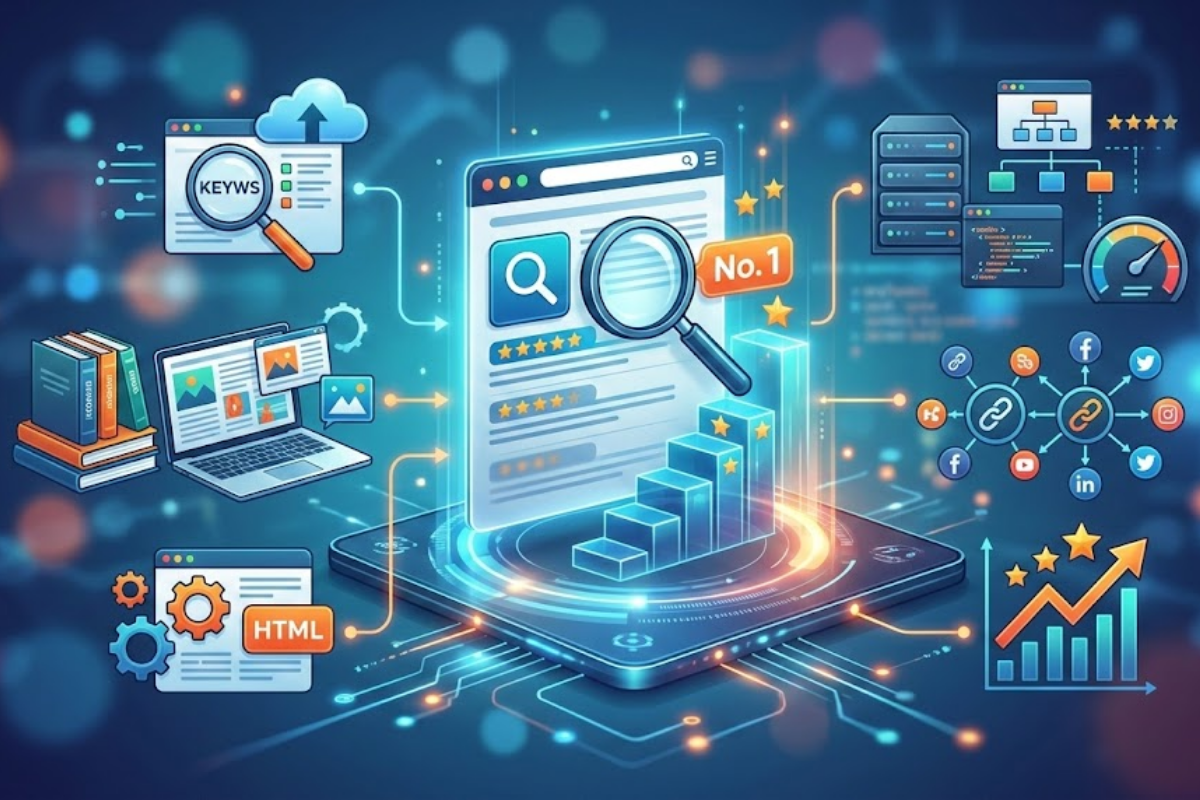
SEO (Search Engine Optimization) is, in Turkish, **arama motoru optimizasyonu** (search engine optimization). It encompasses all technical, content, and authority efforts made to help websites be better understood by search engines like Google, Bing, and Yandex, and to appear more visibly in relevant organic searches. Simply put, SEO is a systematic process that enables your potential customers to find you on search engines.
Over 90% of global searches occur via Google, and 75% of users don't even go past the second page of search results. These figures demonstrate how critical it is for your website to rank high in search results. Implementing SEO is the cornerstone of building a sustainable digital presence without relying on paid advertising.
Modern SEO understanding encompasses much more than just placing keywords on pages, as was once thought. With Google's continuously evolving algorithms, hundreds of factors such as user experience, content quality, technical infrastructure, and site authority play a role in rankings. Especially as AI-powered search features (AI Overviews, AI Mode) began to come into play in 2026, the scope of SEO has further expanded.
At DigitalUp, we increase brands' organic visibility with the services we offer in digital marketing and search engine optimization. In this guide, we will cover every topic you need to know in detail, from the basics of SEO to advanced applications, from how Google works to AI search systems.
What Does SEO Mean and What Does it Stand For?
The **acronym SEO** stands for "Search Engine Optimization." When translated from English to Turkish, it means "Arama Motoru Optimizasyonu." This term is one of the most frequently used and most misunderstood concepts in the digital marketing world.
The primary goal of SEO is to enable search engines to correctly discover, crawl, understand, and most importantly, match your website's content with the right user queries. As stated in Google's official SEO Starter Guide, SEO is defined as "helping search engines understand your content and helping users find your site."
While many people perceive SEO as merely "ranking high on Google," in reality, SEO:
Facilitates reaching the right target audience
Strengthens your website's technical infrastructure
Improves user experience
Helps you build brand authority
Provides long-term organic traffic
The answer to the question "what is Google SEO" is similar because, since Google controls over 90% of the search engine market worldwide, SEO efforts are largely shaped by Google's ranking systems. However, other search engines like Bing and Yandex operate on similar core principles.
What Does SEO Do and Why Do You Need It?
The answer to the question "what is SEO work and what does it do" forms the foundation of your business's digital presence. Organic search is one of the most important sources of traffic to websites, and when done correctly, it becomes one of the marketing channels that provides the highest return on investment.
Increases Organic Visibility
Through search engine optimization, your website becomes visible in organic results for the keywords your target audience searches for. The term "organic" refers to natural search results that are not paid advertisements. Users tend to trust organic results more than ad results.
Drives Qualified Traffic
Visitors who come to your website through SEO are already searching for something related to your product or service. This is called "qualified traffic." For example, a user searching for "women's sports shoe models" for an e-commerce site is a potential customer with purchase intent.
Supports Brand Awareness
Consistently appearing at the top of search results increases your brand's authority and trustworthiness in that field. Users perceive brands on the first page of search results as more reliable.
Builds Long-Term Digital Presence
Unlike paid channels like Google Ads, the impact of SEO efforts is more long-lasting. High-quality content that once ranks high can bring organic traffic for months, even years. This highlights the strategic importance of SEO in digital marketing.
Directly Contributes to Business Goals
Gaining visibility for the right keywords leads not only to increased traffic but also to concrete business results such as:
Lead generation
Sales conversions
Brand searches
Decreased customer acquisition cost
How Does Google Find, Understand, and Rank a Page?
The answer to the question "how does SEO work" first requires understanding how search engines operate. As explained in Google's own documentation, the Search process consists of three main stages:
1. Crawling
Crawling is the process where automated software (bots) called Googlebot discover and visit web pages. These bots systematically traverse billions of pages on the internet.
How does Googlebot discover a page?
**Via external links:** Links from other sites
**Via internal links:** Your site's own menu and content links
**Via XML Sitemap:** Your site's map
**Via URL submission:** Manual submission through Search Console
Crawl budget refers to the crawling resources Google allocates to your site. Large and well-structured sites have a larger crawl budget. A significant portion of technical SEO efforts is aimed at optimizing this crawling process.
2. Indexing
After crawling, Google analyzes the page's content and tries to understand it. At this stage:
Page title
Meta descriptions
Images and alt texts
Words in the content and semantic structure
Structured data (Schema markup)
are evaluated, and the page is added to Google's database (index).
**Important:** A page being crawled does not necessarily mean it will be indexed. Google may choose not to index low-quality, duplicate, or harmful content. The "Crawled - currently not indexed" status seen in Search Console is a common issue encountered at this point.
3. Ranking and Serving Results
When a user enters a search query, Google selects and ranks the most relevant pages from billions in its index. Hundreds of ranking factors come into play during this process:
**Content relevance:** How well does the page match the user's search intent?
**Content quality:** Is the information accurate, up-to-date, and comprehensive?
**User experience:** Does the page load quickly, is it mobile-friendly?
**Site authority:** Is the domain trustworthy, does it have quality backlinks?
**User signals:** Metrics like click-through rate, time on page
**Technical factors:** HTTPS, Core Web Vitals, structured data
Google's ranking algorithm is constantly updated. As of 2026, AI-based ranking systems (language models like MUM, BERT) have become even more advanced.
What are the Types of SEO?
Search engine optimization is not a single effort but consists of different, complementary disciplines. SEO types are broadly grouped into three main categories: technical SEO, on-page SEO, and off-page SEO.
What is Technical SEO?
**Technical SEO** refers to the infrastructure work done to ensure a website is seamlessly crawled, indexed, and performs quickly by search engines. It's an area users don't directly see but directly affects rankings.
Key topics covered in Technical SEO:
**Site speed and performance:** Page loading times
**Core Web Vitals:** LCP, INP, and CLS metrics
**Mobile compatibility:** Mobile-first indexing compliance
**HTTPS:** Secure connection protocol
**XML Sitemap:** Site map
**robots.txt:** Crawling directives
**Canonical tags:** Duplicate content management
**URL structure:** Meaningful and organized addresses
**Structured data (Schema.org):** Explaining content to machines
**Site architecture:** Logical category and page hierarchy
What is On-Page SEO?
The answer to the question "**what is on-page SEO**" is the work done to optimize the content of pages and their internal elements. On-page SEO improves the understandability of the page for both users and search engines.
Key components of On-Page SEO:
Title tag and meta description
H1, H2, H3 heading hierarchy
Keyword and search intent alignment
SEO-friendly content quality
Internal links
Image optimization and alt text
Readability and content structure
What is Off-Page SEO?
**What is off-page SEO?** It encompasses all efforts carried out outside your website to increase its authority and trustworthiness. The most well-known component of off-page SEO is backlinks.
Off-page SEO activities:
**Backlink building:** Links from quality sites
**Digital PR:** Brand mentions and media visibility
**Link building strategies:** Gaining natural and valuable links
**Brand authority:** Building industry reputation
The table below summarizes the key differences between the three main SEO types:
SEO Type | Primary Goal | Example Activities |
|---|---|---|
Technical SEO | For search engines to better crawl and understand the site | Sitemap, site speed, indexing, Core Web Vitals |
On-Page SEO | Optimizing the content of the page | Title, content, H1, internal linking, alt text |
Off-Page SEO | Strengthening site authority | Backlink, digital PR, brand authority |
In addition to these three main categories, specialized sub-fields such as **organic SEO**, local SEO, e-commerce SEO, international SEO, mobile SEO, and image SEO also exist. Each involves specialized strategies tailored to specific business needs.
How is SEO Done? Step-by-Step Process
The question of how to do SEO is the most important point for transitioning from theory to practice. A real SEO effort is a systematic process that proceeds in a specific order. Here are the basic steps followed when performing SEO work on a website:
1. Website SEO Analysis is Performed
Every SEO project begins with an analysis of the current situation. At this stage, technical problems, indexing status, page speed, mobile usability, and site architecture are examined. Search Console data is used to understand current organic performance.
2. Keyword Research is Performed
Determining which words your target audience is searching for is fundamental to the strategy. At this stage:
Search volume
Competition level
Search intent
Long-tail keywords
are analyzed. Correct keyword selection guides the entire content strategy.
3. Content Strategy is Created
A content plan is prepared around the identified keywords. A topic cluster structure is established to aim for topical authority. Content gaps are identified, and content that answers user questions is planned.
4. On-Page Optimization is Performed
Title tags, heading hierarchy, content text, images, and internal links are optimized. Each page is made suitable for its target search intent.
5. Technical SEO is Developed
Site speed is improved, indexing issues are resolved, structured data is added, and the technical infrastructure is strengthened.
6. Authority Building Efforts are Carried Out
Off-page SEO work is conducted to earn quality backlinks and increase brand authority.
7. Results are Measured and Improved
The most critical stage of the "how is SEO work done" process is measurement. Performance is tracked with Search Console and Analytics data, and the strategy is continuously optimized based on the results.
It must be emphasized here: SEO is not a one-time operation but a dynamic process requiring continuous analysis and improvement.
What is the Difference Between SEO and Google Ads?
One of the most commonly confused topics in digital marketing strategies is the difference between SEO and Google Ads. Both provide visibility in search results, but their operating principles are completely different.
Feature | SEO | Google Ads |
|---|---|---|
Visibility type | Organic | Paid |
Payment per click | None | Usually yes |
Time to results | Usually longer term | Fast, depending on campaign |
Traffic continuity | Effect of work can continue for a long time | Dependent on ad budget |
Level of control | More limited | Higher |
Primary goal | Organic visibility | Paid traffic |
Long-term value | Can be high | Dependent on budget |
The most important point is this: with SEO, you don't pay Google per click, and you cannot pay for organic rankings. Google Ads, on the other hand, is a direct paid advertising system.
These two channels are not rivals but complementary. While Google Ads can bring quick results in the short term, SEO allows you to build a long-term and sustainable organic presence. An ideal digital marketing strategy often uses both channels together.
How Long Does It Take for SEO Work to Yield Results?
This is one of the most frequently asked questions by SEO clients and unfortunately one of the most inaccurately answered. Definite promises like "1st rank in 30 days" are unrealistic and typically indicate unreliable SEO approaches.
The time it takes for SEO to show results depends on many variables:
**Domain history:** Is it a new or well-established domain?
**Competition level:** Intensity of competition for target keywords
**Industry:** Some industries are more competitive
**Content quality:** The value and depth of the content produced
**Technical infrastructure:** The technical health of the site
**Backlink profile:** Site authority
**Search demand:** Search volume of the targeted topic
**Strategy applied:** Scope and quality of the SEO work
Generally, significant results on a new site begin to appear within 4-6 months, but in competitive industries, this period can extend up to 12 months. SEO is an investment that requires patience and consistency.
Most Common SEO Mistakes
When applied correctly, SEO yields powerful results; when done incorrectly, it can turn into a waste of time and resources. The most common SEO mistakes include:
**Keyword stuffing:** Artificially cramming keywords into content
**Focusing only on backlinks:** Neglecting content and technical SEO
**Ignoring user intent:** Producing content not aligned with search intent
**Neglecting technical SEO:** Having a slow site with crawling issues
**Increasing only content quantity:** Chasing quantity over quality
**Producing duplicate or low-value content:** Content that adds no unique value
**Not measuring results:** Not progressing data-drivenly
**Viewing ranking as the sole success metric:** Overlooking metrics like traffic, conversions, and revenue
Common Misconceptions About SEO
The world of SEO is full of many myths that have lost their validity over the years but are still circulating. Correcting these misconceptions is the first step to building a sound strategy.
**"SEO is just about keywords."** False. Keywords are an important component, but SEO encompasses many factors such as technical infrastructure, user experience, content quality, and authority.
**"Keyword density should be 2% on every page."** False. There is no specific "keyword density" rule. Google evaluates meaning and context. Artificial keyword repetition is harmful.
**"Sites with many backlinks definitely rank high."** False. Not the quantity, but the quality and relevance of backlinks are important. Spam backlinks can lead to penalties.
**"You pay Google for SEO."** False. No payment is made to Google for organic rankings. This is a common misconception confused with Google Ads.
**"SEO guarantees 1st place."** False. As Google states in its own documentation, no SEO work can guarantee rankings.
**"SEO is a one-time job."** False. SEO is an ongoing process that requires continuous maintenance due to algorithm updates and competition.
SEO and AI Search Relationship
With 2026, the search experience is undergoing a fundamental transformation. Google's AI-powered features like AI Overviews and AI Mode are changing how users access information.
What are AI Overviews?
AI Overviews are summary answers generated by artificial intelligence at the top of Google's search results. When a user asks a question, it summarizes information compiled from multiple sources and provides a direct answer.
What is AI Mode?
AI Mode is an advanced search mode that transforms the search experience into a chat-based structure, allowing users to ask complex questions using natural language.
What is AEO?
**AEO (Answer Engine Optimization)** is an optimization approach that aims for content to appear as a direct answer in AI-based answer engines.
What is GEO?
**GEO (Generative Engine Optimization)** is a next-generation SEO discipline that aims for your brand and content to be cited as sources in generative AI systems.
Is AI Search Replacing SEO?
No. According to Google's current documentation, there is no special "AI SEO technique" or different schema required to appear in AI features. It is sufficient for the page to be indexed and suitable for Google Search. This means that fundamental SEO principles and user-centric quality content fully retain their validity in the age of AI search.
In short, the claim that "completely different SEO is needed for AI" is incorrect. Solid SEO foundations are the key to visibility in both classic search and AI-powered search.
How is SEO Success Measured?
The success of an SEO effort is not measured solely by the question "what rank am I?" Accurate measurement requires evaluating multiple metrics together. Among the most important SEO measurement tools is Search Console, a free Google tool.
Metric | What It Shows? | Tool |
|---|---|---|
Clicks | Number of organic visits | Search Console |
Impressions | Number of appearances in results | Search Console |
CTR | Click-through rate | Search Console |
Average position | Average ranking in search results | Search Console |
Organic traffic | Traffic from search engines | Analytics |
Conversion | Contribution to business goals | Analytics |
In addition to these metrics, indexing status, increase in brand searches, and generated revenue are also important indicators of SEO success. True success is understood when ranking translates into concrete business results.
What Does an SEO Specialist Do?
The answers to the questions "**what is an SEO specialist**" and "**what does an SEO specialist do**" illustrate how comprehensive the field of SEO is. An SEO specialist is a versatile professional who combines technical knowledge with strategic thinking.
Key responsibilities of an SEO specialist:
**SEO analysis:** Evaluating the current state of the site
**Keyword research:** Identifying target keywords
**Content strategy:** Creating a content plan
**Technical SEO:** Resolving infrastructure issues
**On-page SEO:** Performing on-page optimization
**Off-page SEO:** Conducting authority-building activities
**Reporting and measurement:** Analyzing performance
**Continuous optimization:** Updating the strategy
For those looking to learn SEO, this field is a dynamic career path that requires continuous self-improvement. Google's official resources, quality SEO training programs, and practical application are fundamental ways to specialize in this area.
A Real SEO Example: Application Scenario
To put theory into practice, let's examine an example SEO process step by step. This example is based on similar projects we have carried out at DigitalUp.
**Example Website:** An e-commerce site (organic food category)
**Target Query:** "organic olive oil"
**Starting Position:** On the 5th page of search results (position: ~45)
Existing Problems
Issues identified during the technical analysis phase:
Page load time 4.2 seconds (very slow)
Mobile compatibility issues
Missing meta descriptions on product pages
Weak internal linking structure
Insufficient backlink profile
Mismatch in search intent within content
Applied Solutions
**Technical Fixes:**
Image optimization and compression
Activation of caching system
Mobile responsive design improvements
Reducing page speed to 1.8 seconds
**Content Optimization:**
"Organic olive oil" search intent analyzed (mix of informational + transactional)
Detailed information section added to product page
H1-H3 heading hierarchy reorganized
Meta title and description rewritten with a user focus
Alt text added to all images
**Internal Link Strategy:**
Strong links from the main category to product pages
Links from blog content to relevant products with anchor texts
Optimization of "Related products" section
**Search Console Tracking:**
First 2 weeks: No visible change
week: Average position rose to 32
week: Average position 18
week: First page (position 9)
week: Stable at position 4
Organic clicks: 340% increase
Impressions: 180% increase
CTR: Increased from 2.1% to 5.8%
Conversion rate: 18% increase
Monthly organic revenue: 250% increase
**Google Search Console:** Indexing, traffic, and performance tracking
**Google Analytics:** User behavior analysis
**Google PageSpeed Insights:** Page speed measurement
**Google Keyword Planner:** Basic keyword research
**Ahrefs:** Backlink analysis and keyword research
**SEMrush:** Comprehensive SEO analysis and competitor tracking
**Moz Pro:** Domain authority and technical SEO analysis
**Screaming Frog:** Technical site crawling
**Yoast SEO / Rank Math:** On-page optimization for WordPress
**Project scope:** How many pages will be optimized?
**Competition level:** How competitive is the industry?
**Current status:** Will the site be built from scratch or improved?
**Target geography:** Local, national, or international?
**Content need:** Is new content creation required?
**Backlink strategy:** How aggressive a link building is needed?
**User-centric:** People are the primary target, search engines are secondary
**Offers unique value:** Information, experience, and perspective rivals don't provide
**Aligned with search intent:** Users truly find what they are looking for
**Accurate and up-to-date:** Contains no false or outdated information
**Comprehensive:** Covers the topic in sufficient depth
**Experience-rich:** Reflects real experience and expertise
**Responsive design:** Compatible with all devices
**Mobile page speed:** Fast loading
**Touch-friendly elements:** Buttons and links easily clickable
**Readable font size:** Text that doesn't require zooming
**Viewport settings:** Correct viewport configuration
Measured Results
This example demonstrates that SEO optimization is a combination of technical infrastructure, content quality, and strategic internal linking. Results come with patience and consistent work.
SEO Tools and Technologies
Using the right tools is crucial for professional SEO work. Here are the essential tools used in the digital marketing SEO process:
**Free SEO Tools:**
**Paid SEO Tools:**
These tools enable SEO specialists to make data-driven decisions. However, it should be remembered that tools are only aids; the actual value is created by strategy and implementation.
SEO Trends in 2026
Staying current is critically important due to the dynamic nature of SEO. Here are the prominent SEO trends in 2026:
**AI Integration:** AI assistants like Gemini, ChatGPT, and Copilot are changing search behavior. Content should be structured to serve as a source in both classic search and AI chat experiences.
**The Increasing Importance of E-E-A-T:** Experience, Expertise, Authoritativeness, and Trustworthiness factors have become more decisive in Google's content quality evaluation.
**Core Web Vitals:** Page experience metrics (LCP, INP, CLS) play a more significant role in rankings. User experience is no longer optional but a mandatory SEO component.
**Voice and Visual Search:** Optimization for voice assistants and visual search tools like Google Lens is becoming increasingly important.
**Semantic Search:** Google can understand meaning and context beyond just words. Semantic SEO and topic cluster strategies are gaining priority.
**Topical Authority:** Creating deep, specialized content clusters on specific topics is more effective than broad but shallow content.
SEO Packages and Pricing Approach
For those considering SEO services, **SEO packages** and pricing are often a confusing topic. SEO prices in 2026 can vary across a very wide range.
Factors affecting SEO cost:
Warning: Avoid extremely low-priced and guaranteed offers like "1st rank for unlimited keywords for 1000 TL." Quality SEO work requires experienced specialists, tools, and time, hence it has a certain cost.
Transparency and measurability are fundamental in the SEO services we offer at DigitalUp. We develop a special strategy for each project and share progress with monthly reports.
Industry-Specific SEO Implementations
While SEO fundamentals are universal, implementation strategies differ by industry. Here are specialized approaches for common industries:
**E-commerce SEO:** Product page optimization, category structure, product descriptions, user reviews, and structured data (schema) play a central role. Technically, page speed and mobile experience are critical.
**Local SEO:** For local businesses, Google Business Profile optimization, local keywords, customer reviews, and NAP (name-address-phone) consistency are vital.
**Corporate SEO:** For large-scale sites, technical infrastructure, site architecture, managing a large number of pages, and corporate content strategy are paramount.
**Blog/Content SEO:** In information-centric sites, search intent analysis, topic cluster structure, long-tail keywords, and E-E-A-T signals are decisive.
Each industry has its unique SEO needs, and therefore, customized approaches are required instead of copy-paste strategies.
How to Build a Forward-Looking SEO Strategy
For sustainable SEO success, it's necessary to think long-term strategically rather than short-term tactics. Here are the fundamentals of building a comprehensive SEO strategy:
**1. Define Your Business Goals:** Do SEO for concrete business results, not just for the sake of doing SEO. Goals should be leads, sales, and revenue, not just traffic.
**2. Deeply Understand Your Target Audience:** Research your customers' search behaviors, problems, and search intents. Conduct persona work.
**3. Perform Competitor Analysis:** Identify your competitors' strengths and weaknesses. Reach what they've achieved and differentiate yourself in areas they've neglected.
**4. Solidify Your Technical Foundation:** Before fancy tactics, ensure your site's technical infrastructure is robust. Build a crawlable, fast, and secure site.
**5. Map Out Your Content:** On which topics will you establish authority? Plan your main pillar pages and supporting content using a topic cluster approach.
**6. Proceed Data-Drivenly:** Base every decision on data. Regularly collect data from Search Console, Analytics, and SEO tools, analyze it, and update your strategy accordingly.
**7. Be Patient and Consistent:** SEO is a marathon, not a sprint. Consistent, quality work yields results over time.
The Importance of Content Quality in the Age of AI
As content creation becomes easier with AI tools, content quality is more critical than ever. Google's "helpful content" updates penalize low-value content produced solely for search engines.
**What is quality SEO content?**
AI-powered content generation tools can help, but content published without human editing, unique perspective, and real experience fails in the long run.
Mobile's Role in SEO
Google has been implementing a "mobile-first indexing" approach since 2019. This means Google uses a site's mobile version as the primary source for indexing and ranking.
As of 2026, the proportion of searches made from mobile devices has exceeded 60%. Therefore, mobile SEO is no longer an option, but a necessity:
A site with a poor mobile experience will be at a disadvantage in rankings, no matter how good it is on desktop.
SEO in International Markets
International SEO is critically important for businesses serving multiple countries or languages. This area involves much more complex technical and strategic requirements than local SEO:
**Hreflang tags:** For language and region targeting
**ccTL
Frequently asked questions
What is SEO?+
SEO (Search Engine Optimization) is the sum of technical, content, and authority efforts made to help websites be better understood by search engines and become more visible in organic searches.
What does SEO mean?+
SEO is an abbreviation for "Search Engine Optimization", and it means "Arama Motoru Optimizasyonu" in Turkish.
What does SEO do?+
SEO increases your website's organic visibility, brings in qualified traffic, supports brand awareness, and reduces your customer acquisition cost in the long run.
How is SEO done?+
SEO is done through technical analysis, keyword research, search intent analysis, quality content production, on-page optimization, technical improvements, and authority building efforts.
Why is SEO important?+
75% of users do not go to the second page of search results. SEO is one of the most effective digital marketing channels that allows your target audience to find you.
What are the types of SEO?+
The basic types of SEO are technical SEO, on-page SEO, and off-page SEO. In addition to these, there are specialized areas such as local SEO, e-commerce SEO, and international SEO.
Is SEO free?+
Google is not paid for organic rankings, in this sense, it is "free". However, professional SEO work has a cost because it requires expert labor, tools, and time.
How long does it take for SEO to yield results?+
It is not possible to give an exact timeframe. Depending on competition, industry, site history, and the strategy applied, the first meaningful results usually start to be seen within 4-6 months.
What is the difference between SEO and Google Ads?+
SEO provides organic visibility and does not require payment per click. Google Ads, on the other hand, is a paid advertising system, and visibility stops when your budget runs out. Both are complementary channels.
What does an SEO specialist do?+
An SEO specialist performs technical analysis, keyword research, content strategy, on-page and off-page optimization, performance tracking, and continuous improvement efforts.
Is learning SEO difficult?+
While the fundamentals of SEO are accessible, mastering it in-depth requires technical knowledge, marketing acumen, analytical thinking, and continuous learning. It is a field of moderate difficulty.
What is the most important factor in SEO?+
There isn't a single "most important" factor. Google evaluates hundreds of factors together. However, content quality, search intent alignment, technical health, and site authority are among the most critical components.
Sources
- Google Search Central - SEO Başlangıç Kılavuzu
- Google Search Central - How Search Works
- Google Search Central - Creating Helpful Content
- Google Search Central - AI Features ve Web Siteniz
- Google Search Console Dokümantasyonu
- Bing Webmaster Guidelines
- Google AI Optimization Guide
- Scrapeless. (2025). GEO vs SEO: The Fundamental Shift in Search Engine Optimization in 2026.

Recep Bayoğlu
SEO Team Leader
If you want to talk more about this topic or need a tailored solution for your brand, you can reach me directly.
Our Services
Related Services
Google Ads Management
Top pickUse your ad budget most efficiently with professional Google Ads management.
Meta (Facebook & Instagram)
Reach your target audience with Facebook and Instagram ads.
SEO Consulting
Rank higher in search engines and grow organic traffic.
GEO Consulting
Get cited as a source inside ChatGPT, Gemini and Perplexity answers.
Social Media Management
Strengthen your online presence with professional social media management.
E-Commerce Solutions
T-Soft, İkas, Ticimax and İdeasoft infrastructures.
TikTok Ads
Reach young audiences with TikTok ads.
Video Production
Professional 4K video production services.
Web Design
Modern user-friendly web design.
Yandex Ads Management
Reach Russian and CIS markets with Yandex ads.
Telegram Ads Management
Reach audiences directly with Telegram sponsored messages.
ChatGPT Ads Consulting
Position your brand in the in-chat advertising ecosystem.
Gemini Ads Consulting
Gain an early advantage in Google AI Mode ads.
T-Soft E-Commerce Site
T-Soft infrastructure for enterprise scale.
İdeasoft E-Commerce Site
Flexible and powerful e-commerce infrastructure.
İkas E-Commerce Site
Fast setup, modern e-commerce infrastructure.
Ticimax E-Commerce Site
Scalable e-commerce solution.
More from this category

digitalup What Are SEO Services? What Does Search Engine Optimization (SEO) Service Cover?
digitalup What is a Knowledge Graph?
digitalup Can SEO Be Done With Artificial Intelligence? (Step-by-Step AI SEO Guide)