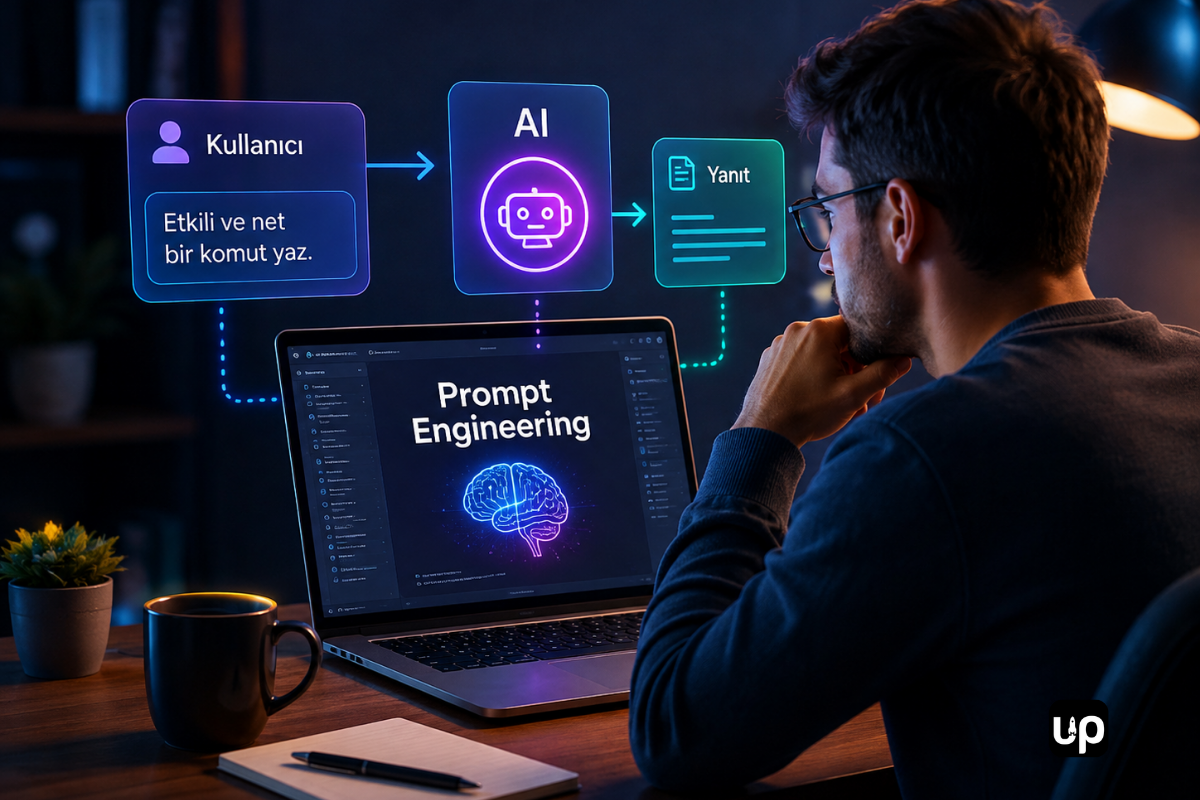
The question of "what is prompt engineering" has moved to the forefront of the technology world as generative artificial intelligence systems integrate into daily business processes and digital infrastructures. Crafting the right commands when communicating with Large Language Models (LLMs) directly determines the quality of the responses received. Properly managing AI prompt preparation processes through prompts dramatically increases the efficiency obtained from the system.
What is Prompt Engineering?
Quick Answer: Prompt Engineering is the process of strategically designing and optimizing input commands (prompts) to generate accurate, consistent, and high-quality outputs from Large Language Models (LLM) such as ChatGPT, Gemini, and Claude.
Prompt engineering is a methodological discipline that enables natural language processing models to produce responses aligned with a desired goal. Context, role definition, and constraints within the command structure form the basic framework of AI prompt writing efforts.
How Do Large Language Models (LLMs) Process Prompts?
Large language models process user-provided AI commands by converting words and relationships into mathematical vectors. During the GPT prompt creation process, the model calculates probabilities to predict the next logical word. This explains why prompt optimization steps require precise and clear inputs.
Why is Prompt Engineering Critical in AI Communication?
Properly designed AI prompt techniques prevent the system from generating misinformation and enable it to focus directly on solutions. Adopting prompt engineering approaches from scratch saves time in complex analyses.
Reducing the Risk of Hallucination (Error)
When language models generate inconsistent or fabricated information, it is defined as "hallucination." By adhering to the rules of how to write effective prompts, setting boundaries for the model, and providing reference texts, the model's rate of providing fact-based answers increases.
Increasing Output Quality and Time Efficiency
Applying the principles of how to write good prompts eliminates repetitive correction processes. With a single structured instruction, analyses or AI content generation that would take hours can be completed in minutes.
Key Components of an Effective Prompt
A successful AI prompt preparation process is built on 4 core elements:
Role (Persona): The identity of expertise assigned to the model.
Context: The background of the task and the target audience.
Task: The concrete action requested from the AI.
Constraints and Format: The length, tone, and formal rules of the output.
Advanced Prompt Engineering Techniques
Featured Snippet Summary Box:
Advanced prompting techniques are fundamentally divided into three structures:
Zero-Shot: Requesting a direct answer without providing prior examples.
Few-Shot: Providing a few examples to teach the model the correct structure.
Chain-of-Thought (CoT): Guiding the model to think step-by-step to solve complex problems.
As prompt design methods evolve, the models' problem-solving capacity also increases. Advanced prompt structures are designed to solve complex problems in a logical sequence.
Zero-Shot and Few-Shot Prompting
In the Zero-shot approach, a question is directly posed to the model without any examples. In the Few-shot technique, 1-3 example input and output pairs related to the desired output format are added. The few-shot method, which is among AI prompt techniques, significantly reduces formal errors.
Chain-of-Thought (CoT) Logic
For problems requiring logical inference, the model is instructed to "think step by step." The Chain-of-Thought method increases the likelihood of reaching the correct result by making the model's processing steps transparent.
Tree of Thoughts (ToT) and System Prompt Architecture
In the Tree of Thoughts architecture, the model compares decisions by creating different probability trees. A System prompt, on the other hand, is a background parameter that defines the main identity and behavioral boundaries the AI will maintain throughout the session.
Bad vs. Good Prompt: Applied Comparison
Distinguishing between correct and incorrect approaches in the ChatGPT prompt preparation process directly affects the quality of the results.
Parameter | Weak / Bad Prompt Example | Optimized / Good Prompt Example |
Input (Prompt) | "Write me an article about SEO." | "You are a 10-year senior SEO expert. Prepare an informative guide of 500 words, in bullet points, covering technical SEO trends for e-commerce sites in 2026." |
Missing Areas | No role, no context, uncertain format and length. | Role (Persona) defined, target audience specified, output format and constraints clear. |
Output Quality | Superficial, generic, and unhelpful response. | Target-oriented, directly actionable response. |
Prompt Parameters According to AI Models (ChatGPT, Claude, Gemini)
Different LLM architectures process prompt parameters in various ways:
Temperature: Ranges from 0.0 to 1.0. Lower values provide precise and consistent answers, while higher values increase creativity.
ChatGPT (OpenAI): Shows high compliance with system prompts and detailed instructions.
Claude (Anthropic): Successfully handles long context windows and document analyses.
Gemini (Google): Works with direct integration of current search data and multimodal inputs.
Prompt Security: Prompt Injection and Jailbreaking Risks
The question of "what is prompt engineering for" is not limited to content generation; it also encompasses security layers.
Prompt Injection: Attackers manipulate the system prompt by giving hidden instructions to the AI system.
Jailbreaking: The process of forcing the model to produce restricted content by bypassing security filters. Secure command design minimizes these risks with input validation constraints.
Prompt Optimization for GEO and AEO (For AI Search Engines)
Generative AI Search Engines (SearchGPT, Perplexity, Gemini) focus on natural language structure when processing content. By leveraging DigitalUp AI Content Creation solutions in digital strategies, designing texts compatible with GEO (Generative Engine Optimization) and AEO (Answer Engine Optimization) allows you to stand out in AI summary fields.
Direct answer paragraphs of 40-50 words should be placed immediately under H2 headings.
Entity-based semantic relationships should be clearly established.
Transform Your AI Strategy with Command Design
Well-structured AI prompts accelerate operational processes, reduce error rates, and multiply productivity. With current guides and transformation-focused AI solutions offered on our DigitalUp platform, you can strengthen your digital presence and elevate your business processes to the next level.
Sources

Recep Bayoğlu
SEO Team Leader
If you want to talk more about this topic or need a tailored solution for your brand, you can reach me directly.
Our Services
Related Services
Google Ads Management
Top pickUse your ad budget most efficiently with professional Google Ads management.
Meta (Facebook & Instagram)
Reach your target audience with Facebook and Instagram ads.
SEO Consulting
Rank higher in search engines and grow organic traffic.
GEO Consulting
Get cited as a source inside ChatGPT, Gemini and Perplexity answers.
Social Media Management
Strengthen your online presence with professional social media management.
E-Commerce Solutions
T-Soft, İkas, Ticimax and İdeasoft infrastructures.
TikTok Ads
Reach young audiences with TikTok ads.
Video Production
Professional 4K video production services.
Web Design
Modern user-friendly web design.
Yandex Ads Management
Reach Russian and CIS markets with Yandex ads.
Telegram Ads Management
Reach audiences directly with Telegram sponsored messages.
ChatGPT Ads Consulting
Position your brand in the in-chat advertising ecosystem.
Gemini Ads Consulting
Gain an early advantage in Google AI Mode ads.
T-Soft E-Commerce Site
T-Soft infrastructure for enterprise scale.
İdeasoft E-Commerce Site
Flexible and powerful e-commerce infrastructure.
İkas E-Commerce Site
Fast setup, modern e-commerce infrastructure.
Ticimax E-Commerce Site
Scalable e-commerce solution.
More from this category

digitalup What Is Zero-Click Search?

digitalup What is Programmatic SEO (pSEO)? A Guide to Scalable Traffic with Thousands of Pages

digitalup What is SEO? The Evolution of Search Engine Optimization in 2027 and Beyond