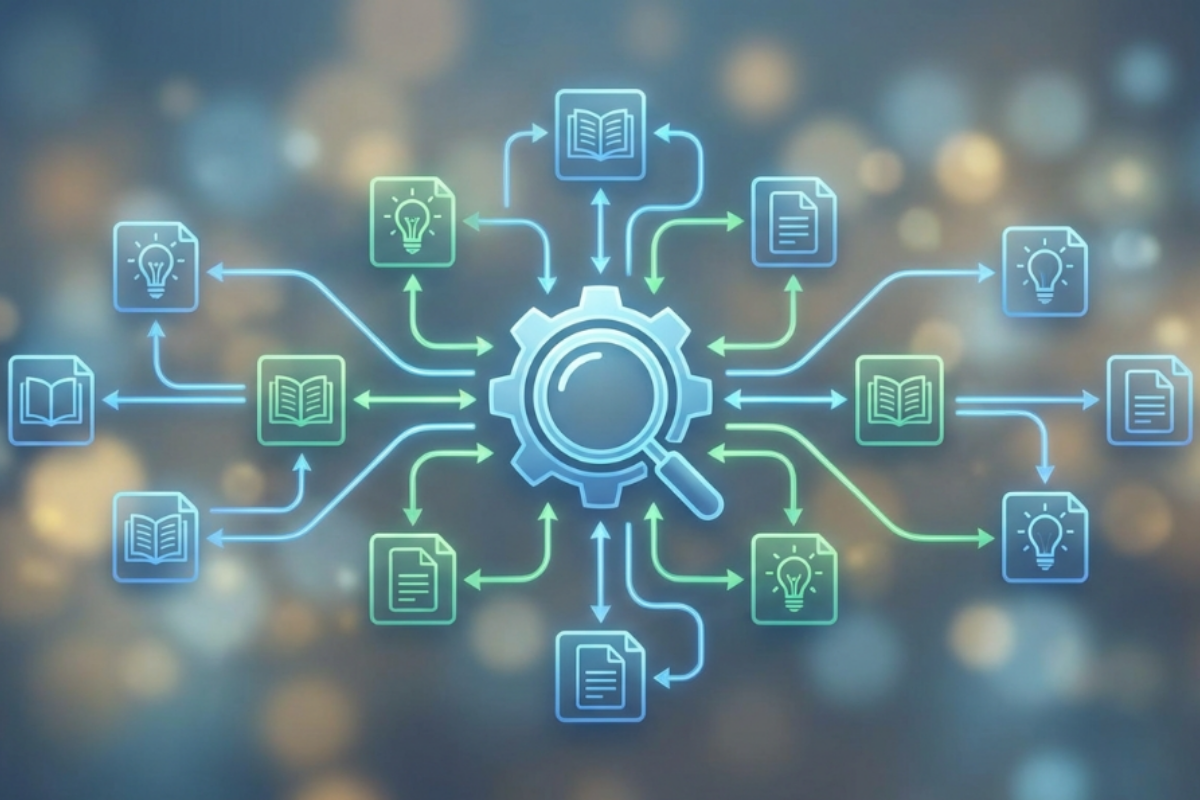
Your website is like a gigantic digital library; but without the right shelves and directions, your visitors and search engine bots are bound to get lost in this labyrinth. The question "What is Internal Linking? How to Do It?" is no longer just a technical preference in the 2026 SEO ecosystem, but the most powerful way to prove your content authority. According to Creamaxi source's February 2026 Discover update analysis, Google no longer just looks at keyword matches; it rewards the semantic integrity and "topical authority" that your site offers. If you want to make your traffic permanent, you must build the bridges between your pages with a strategic architecture, not randomly. Building authority is the key to visibility in 2026.
Internal Linking: Conceptual Foundations
Internal linking, at its most basic definition, refers to the digital bridges established from one page to another within the same domain. According to WhitePress and Wibrit sources, this structure is considered an "art of navigation" that determines your site's hierarchy and distributes authority among pages. Search engine bots (crawlers) navigate your site by following these bridges from one page to another. If these bridges are missing, bots cannot reach the depths of your site, and your pages remain in a "digital graveyard" without being indexed. Technically, a bot analyzes a link on your site using four main components:
- Start of Link Tag (
<a>): This is the starting tag of the system; it whispers to bots that a link follow is beginning. - Link Referral Location (
href): This is the target address of the link, determining where the visitor will go when they click. - Visible / Anchor Text: This is the clickable text the user sees on the screen. Google considers this text the most critical clue about the target page's content.
- Closure of Link Tag (
</a>): This is the closing tag that indicates the end of the link tag.
These components are not just technical requirements, but tools that create the semantic map of your site. Thanks to internal links, both users and bots clearly understand which topics your site specializes in.
Why is it Important? The Critical Connection Between SEO and User Experience (UX)
Internal links are the lifeblood of a website. If you don't have a proper link structure, you'll waste your crawl budget even if you produce the highest quality content. According to Ideamagix data, Googlebot establishes a hierarchy of "importance" by following links when crawling a website. "Orphan pages" that don't receive links from anywhere cannot rank because bots cannot discover them. Strategic internal linking ensures that your new or updated content is indexed within hours by efficiently using Google's limited crawl budget allocated to your site. Moreover, INP (Interaction to Next Paint), the most critical metric of 2026, indirectly tests the efficiency of internal links when measuring the speed of page transitions for users.
The concept of PageRank is still at the heart of SEO. Your homepage or an article that receives powerful backlinks transfers its "link juice" to subpages. So why is this important? Because this transfer enables your subpages to rank higher by increasing their authority for keywords where competition is very high. On the user side, properly structured links effortlessly guide the visitor from one topic to another. An increase in time spent on site and a decrease in bounce rate send the message to Google: "This site is valuable and relevant." The more natural and guiding your links are, the more stable your SEO score will remain.
The Indispensable of 2026: Topic Clusters and Pillar Page Model
As synthesized by Flatart and Ideamagix sources, in the 2026 SEO world, scattered content production has been replaced by "Topic Clusters." This model is a hierarchical structure used to solidify your site's authority on a specific topic. A "Pillar Page" (Column Page) that generally covers the main topic is created, and from this page, links are given to "Cluster Content" pages that delve deeply into sub-topics.
|
Component |
Function |
Linking Direction |
|
Pillar Page |
Central content generally covering the main topic |
Towards Cluster content |
|
Cluster Content |
Pages that delve deeply into sub-topics |
Back to Pillar Page |
|
Internal Links |
Semantic connection between pages |
Bi-directional (Loop) |
The most concrete example proving the success of this strategy is the experience of SEO expert Samuel Schmitt. Between May and October 2020, Schmitt broke down a long-form content piece and converted it to this model; he quickly increased the weekly view count from 50 to 2,000, achieving a 1000% traffic increase with a total of 16,000 views. This success story demonstrates the immense impact of semantic integrity and bi-directional link loops on Google algorithms.
Anchor Text Strategy: What Message Are You Sending to Google?
Anchor text is the digital identity of the page you are linking to. According to Argenova and Ideamagix guides, using generic phrases like "click here" is a big mistake in the 2026 SEO vision and a strategic loss. Google analyzes the words in the anchor text to understand which searches the target page should match. For example, using "Comprehensive SEO analysis guide" instead of just "SEO Analysis" sends a much clearer signal to bots about the depth and context of the target page. You should use the following types in a balanced way in your strategy:
- Exact Match: Directly using the target keyword (e.g., "Internal Linking").
- Partial Match: Variations of the keyword (e.g., "How to build internal linking strategies?").
- Semantic/LSI Links: Supporting side concepts and synonyms related to the main topic.
Critical Warning: Constantly using the same "exact match" keyword in all internal links can be perceived as over-optimization and carry a spam risk. You should embed your links in the natural flow of the text, guiding the user to information without manipulation. Remember, your anchor texts are promises you make to Google; the target page must keep this promise.
Technical Implementation: How to Do Internal Linking?
When designing your internal link structure, you should act with the meticulousness of an architect. Professional application steps, based on WhitePress and Wibrit sources, maximize your site's crawlability. The first rule is the 3-Click Rule (Crawl Depth): As Ideamagix emphasizes, even the deepest page should be no more than 3 clicks away from the homepage. If content is 4-5 clicks deep, you have devalued that page in the eyes of bots.
Another critical tactic is to build bridges from old articles to new articles during Content Refresh periods. By updating your old authoritative articles and linking them to your newly published "cluster" content, you immediately provide "fresh water" to the new content. Link placement is also of vital importance; Google gives more weight to links in the first 30% of the page. Therefore, try to present your most important directions in the introductory sections. Also, remember that the "Alt Text" fields you add to your images are read by Google like an anchor text; use images not just as decoration, but as linking opportunities.
Linking Strategies in the Age of Artificial Intelligence (AI) and GEO
As of 2026, systems like Perplexity, SearchGPT, and Google AI Overview synthesize web resources while directly answering user questions. According to DexterGPT and Creamaxi analyses, AI engines are synthesizers, not content creators. These engines need robust, structured, and reliable sources to generate answers. Generative Engine Optimization (GEO)-compliant linking is the most effective way to provide context for your content to AI bots.
In your 2026 strategy, you must use a modular structure. DexterGPT's "Senior" advice is this: Provide clear, 1-2 sentence definitions under each H2 heading. AI bots will quote these definitions directly, crediting you as the source. Content connected by a strong link network is perceived as an "authority cluster" by AI engines. This is crucial not only for Google rankings but also for your brand to be referenced in AI summaries. Your linking strategy should now be designed not just for bots, but for algorithms to synthesize content.
Performance Analysis: GA4 and Search Console Integration
To measure the success of your internal linking strategy, you must proceed data-driven. According to the İçerikmatik guide, the first step is to integrate these two tools by going to Admin > Product Links > Search Console via GA4. Here lies a critical "insight" for professionals: While the Google Search Console panel normally provides you with a maximum of 1,000 rows of data, GA4 integration allows you to access in-depth data analysis of 7,510 or more (in some queries 19,570+) rows.
Identify pages with a low "Average Engagement Time" via GA4; these pages are likely dead ends. You can improve performance on these pages by adding engaging internal links that will keep the user on site. Also, use the "Internal Links" report in Search Console to identify pages with the fewest links. By performing an "Orphan Pages" scan with tools like Screaming Frog, bring back valuable content that has fallen outside the hierarchy. Data is the only honest mirror where you can see your linking errors.
5 Deadly Mistakes You Should NEVER Make
To protect your site's SEO health, you should avoid the following 5 mistakes highlighted by Ideamagix and Wibrit:
- Adding "nofollow" to internal links: This signals that you don't trust your own content and cuts off the flow of authority. This means "locking your own door."
- Constantly using the same anchor text: This creates a manipulative perception and can cause you to fall into Google's over-optimization filters.
- Linking irrelevant pages: This degrades the user experience and makes it difficult for Google to understand your site's main topic (topical relevance).
- Opening all internal links in a new tab: According to Wibrit, this disrupts the user experience and overloads mobile browsers. Don't break the user's flow.
- Link stuffing: Adding more than 150-200 links per page, thereby excessively diluting link authority and killing readability.
The Final Step for a Conversion-Oriented Site Architecture
Internal linking is not a static structure but a living strategy that needs continuous nurturing. If you want to get ahead of your competitors in the 2026 SEO world, start today by identifying the 3 articles on your site that receive the most traffic. From these authoritative pages, strategically link to your new "cluster" content that you want to drive traffic to, and observe the semantic power of these bridges. Remember, every link is not just a connection, but a declaration of trust you give to Google and AI engines.
Frequently asked questions
Does internal linking directly affect SEO score?+
Yes, it directly affects it. Internal links determine search engine crawlability, page authority distribution (PageRank), and the semantic relationship between content. A correct structure allows Google to recognize your site as a "subject matter expert," which boosts the ranking power of the entire site. It also provides 100% positive contribution to indexing speed as it technically increases crawlability.
How many internal links should be in a blog post?+
While there isn't a definitive number, 5-10 natural links are considered ideal for a 1,000-word post. However, the fundamental rule is that the link should provide value to the user. According to Ideamagix's advice, rather than scattering links randomly throughout the text, linking to the most important pillar pages within the first 30% of the page is much more strategic for authority transfer.
Is linking images (via Alt Text) effective?+
Absolutely. Google reads the "Alt Text" field in image links like an anchor text. Especially links made from infographics or banners, both support visual SEO and offer a more natural appearance by diversifying your site's link profile. According to the Argenova guide, adding descriptive and keyword-rich alt text to images also increases your accessibility score.
Why are "Breadcrumbs" critical in internal linking?+
According to Zeo and Google Search Central data, Breadcrumbs are a navigation element that shows the user where they are on your site and explains the hierarchy clearly to bots. When integrated with JSON-LD Schema markup, they allow you to appear as a Rich Snippet in Google search results (SERP). This increases your click-through rate (CTR) while making it easier for bots to understand your site architecture.
Should I use automatic internal linking tools (Semrush, LinkWhisper, etc.)?+
These tools are very useful for saving time on large websites. AI-powered tools like Semrush analyze your content and semantically suggest linking opportunities you might have missed, with one-click implementation. However, it is always vital for a specialist to perform the final check to preserve the natural language flow and user intent.
Sources

Recep Bayoğlu
SEO Team Leader
If you want to talk more about this topic or need a tailored solution for your brand, you can reach me directly.
Our Services
Related Services
Google Ads Management
Top pickUse your ad budget most efficiently with professional Google Ads management.
Meta (Facebook & Instagram)
Reach your target audience with Facebook and Instagram ads.
SEO Consulting
Rank higher in search engines and grow organic traffic.
GEO Consulting
Get cited as a source inside ChatGPT, Gemini and Perplexity answers.
Social Media Management
Strengthen your online presence with professional social media management.
E-Commerce Solutions
T-Soft, İkas, Ticimax and İdeasoft infrastructures.
TikTok Ads
Reach young audiences with TikTok ads.
Video Production
Professional 4K video production services.
Web Design
Modern user-friendly web design.
Yandex Ads Management
Reach Russian and CIS markets with Yandex ads.
Telegram Ads Management
Reach audiences directly with Telegram sponsored messages.
ChatGPT Ads Consulting
Position your brand in the in-chat advertising ecosystem.
Gemini Ads Consulting
Gain an early advantage in Google AI Mode ads.
T-Soft E-Commerce Site
T-Soft infrastructure for enterprise scale.
İdeasoft E-Commerce Site
Flexible and powerful e-commerce infrastructure.
İkas E-Commerce Site
Fast setup, modern e-commerce infrastructure.
Ticimax E-Commerce Site
Scalable e-commerce solution.
More from this category
digitalup What Are SEO Services? What Does Search Engine Optimization (SEO) Service Cover?
digitalup What is a Knowledge Graph?
digitalup Can SEO Be Done With Artificial Intelligence? (Step-by-Step AI SEO Guide)