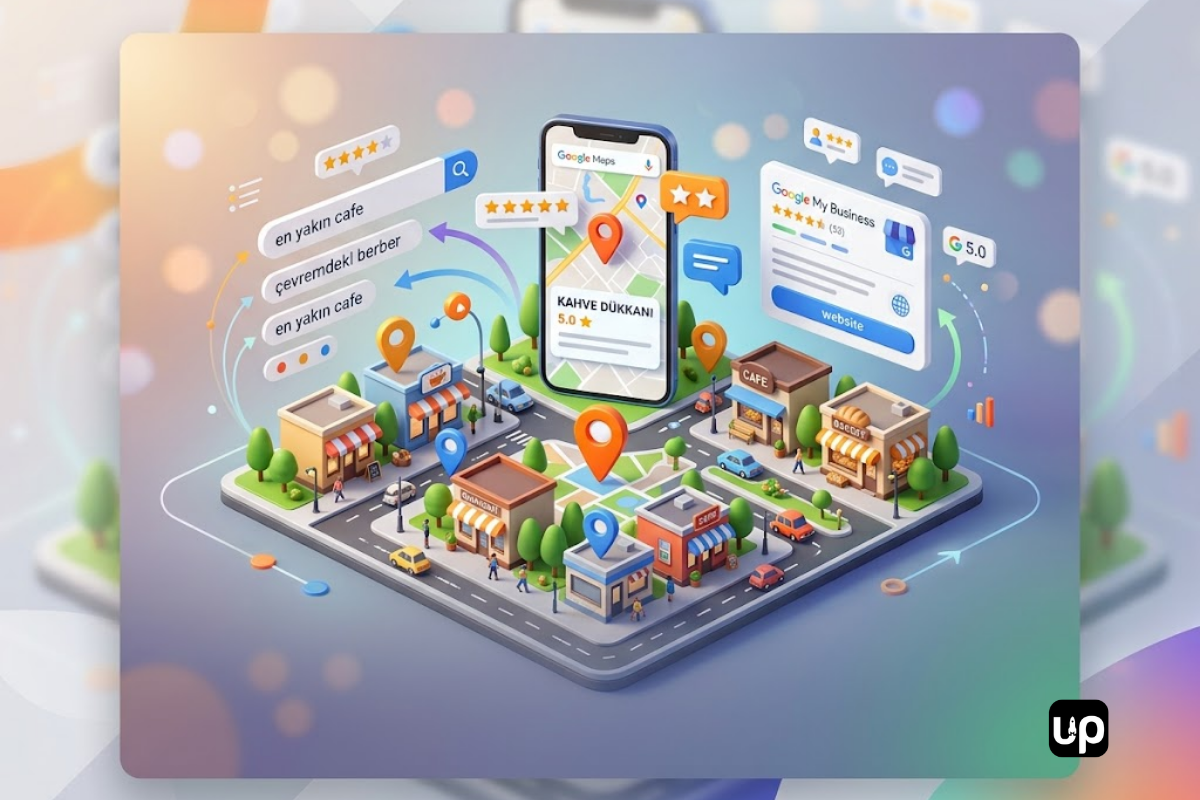
What is Local SEO and how does it change the destiny of your business in the digital world? Simply put, it is a set of strategies that allow local customers to reach your physical store, shop, or services offered in a specific region exactly when they need them.
Especially in today's world where smartphones are at the center of our lives, the vast majority of users turn directly to search engines when they need a service. If you are a restaurant, a dental clinic, or a plumber, not appearing on the first page of search results means losing your potential customers directly to your competitors. Standing out in today's competitive markets means optimizing your digital presence for the audience in your target region.
Quick Summary: Local SEO is a search engine optimization applied to physical stores or businesses serving a specific geographical area. Its main goal is to increase phone calls, direction requests, website visits, and store traffic by ranking high in Google Maps and location-based search results.
If you want your business to be more visible in Google Maps and local search results, you can quickly establish your regional dominance with DigitalUp's professional SEO solutions and strategies. In this guide, starting with the question of how to do local SEO within the understanding of a local SEO guide, we will examine all local SEO techniques and 2026 trends step by step.
What is Local SEO?
Local SEO (Local Search Engine Optimization) is a customized SEO process that allows businesses to be more visible to search engines in internet searches performed in a specific geographical location. When users search on Google for "plumber near me", "Kadıköy dentist", or directly "breakfast places", algorithms list the closest and most relevant results to the user's location. This is where local SEO, or as it is also called, regional SEO, comes into play, enabling your business to meet your target audience directly.
Local SEO Definition and Scope
While the goal in general SEO efforts is to achieve high website traffic globally or nationally, local search engine optimization directly targets potential customers who will make a physical visit or are in the service area. If we were to give a technical answer to the question of what local SEO is; it is the sum of all optimizations made for map services (Google Maps, Apple Maps), "Local Pack" areas in search engine results pages (SERP), and location-oriented organic listings.
This process requires the flawless functioning of location-specific local keywords, properly structured NAP (Name, Address, Phone) information, user reviews, and digital directory listings (citations).
Difference from Traditional SEO
Many business owners may have difficulty understanding the difference between local SEO and general SEO. Although both approaches aim to adapt to search engine algorithms, there are significant differences in terms of target audience, strategy, and tools used.
Traditional SEO: Aims to reach national or international user audiences searching for information, products, or services without being tied to a physical location. Backlink profile, general content marketing, and on-site technical optimizations are at the forefront.
Local SEO: Directly targets users in the specific geographical location. Google Maps visibility, creating a Google Maps listing steps, map reviews, and local directories are the most critical success criteria.
Organic SEO vs. Local SEO Comparison
The table below clearly shows the main differences between the two approaches:
Feature | Local SEO | Traditional (Organic) SEO |
Main Target Audience | Users in a specific city, district, or region | All national or international users |
Primary Platforms | Google Maps, Google Business Profile, Local Pack | General Google SERP, Images, News |
Key Success Criterion | NAP Consistency, Reviews, Proximity to Location | Authoritative Backlinks, In-depth Content |
Conversion Type | Store visit, phone call, directions | Form submission, e-commerce sale, content reading |
GBP Usage | Mandatory and Critical | Optional / Secondary |
Why is Local SEO Important?
Today, consumer purchasing behavior is entirely shaped by mobile devices and location-based searches. Local SEO for businesses is not just an effort to establish a digital presence, but also a vital marketing channel that directly impacts revenue. According to 2026 search data, 76% of "near me" searches made from mobile devices result in a physical business visit on the same day.
LOCAL SEARCH CONVERSION CYCLE | |
Step 1 | [User Search] ("Best Restaurant Near Me") |
Step 2 | [Google Local Pack Display] (Map + GBP Profile) |
Step 3 | [Trust Factor] (High Rating + Positive Customer Reviews) |
Step 4 | [Action Taken] (Get Directions or Direct Call) |
Step 5 | [Physical Store Visit and Sale] |
Attracts Local Customers
Local searches are search queries with the highest commercial intent. If a user searches for "Izmir emergency locksmith", it is not to get information, but to get a service immediately. Thanks to well-designed local SEO strategies, you can appear first to these local customers with high purchasing potential.
Provides Visibility on Google Maps
Google Maps SEO efforts move your business to the top not only in standard search results but also directly in map applications. Users prefer map-based interfaces when examining businesses in an area. Ranking high on maps increases trust in your brand and helps you get ahead of your competitors.
Increases Sales and Phone Calls
A Google My Business SEO optimized profile offers users the ability to call your business or get directions with a single click. This allows your direct sales channels to operate without even needing to visit your website. The "Call Now" buttons in mobile search results dramatically increase local conversion rates.
Captures Mobile Users
With over 65% of search traffic coming from mobile devices, users with active location services are constantly looking for solutions near them. A mobile-friendly and location-focused local SEO effort is the most effective way to attract mobile users on the road or in the vicinity to your store instantly.
How Local SEO Works?
Search engines use complex algorithms to provide the most accurate and relevant results for users' location-based searches. To succeed in local SEO optimization, it is necessary to understand how these algorithms make decisions in the background. Google primarily evaluates three main criteria when determining local search results and "Local Pack" (map trio) rankings.
GOOGLE LOCAL RANKING ALGORITHM | ||
RELEVANCE | DISTANCE | PROMINENCE |
Keywords | User Location | Reviews & Ratings |
Category Selection | Business Address | Backlink Profile |
Service Details | Service Area | Digital Citation |
How Google Determines Local Results?
Google's local search algorithms are based on matching a user's search intent with the services offered by a business. When a user searches for "best Italian restaurant", Google selects the most suitable ones from thousands of businesses in its database. In this selection phase, the completeness of your business profile, your local signals, and your digital authority are scored together. Local SEO criteria consist of a balanced combination of these three main pillars.
Relevance
Relevance measures how well your business matches a user's search query. If you haven't clearly defined the services you offer in your profile and website, Google algorithms cannot match you with relevant searches.
Category Selection: Choosing the correct primary and secondary categories when performing Google Business Profile optimization directly affects relevance.
Detailed Service Descriptions: All products and services offered by your business must be added individually to your profile.
Keyword Consistency: It is important that local content on your website and texts in your business profile contain consistent local keywords.
Distance
Distance is the distance between the physical location of the searching user and the address of the business to be shown in the search result. If the user has not specified a location during the search (e.g., just typed "coffee shop"), Google prioritizes businesses closest to the location obtained from the device's GPS or IP data.
Location Accuracy: It is critical that your address is marked on the map with millimeter precision.
Service Area Businesses (SAB): If you are a business that provides services to an address rather than hosting customers at your address (e.g., plumber or courier), you must correctly define your service areas.
Prominence
Prominence or recognition represents how well-known and trustworthy a business is in the digital world. Even if the distance or relevance is high, a business with low recognition struggles to rank high.
Reviews and Ratings: Having high ratings and many customer reviews is the biggest factor increasing prominence.
Digital Footprint (Citation): The frequency with which your business name, address, and phone number (NAP) appear in online directories and local sites is evaluated.
Traditional SEO Authority: Quality backlinks and domain authorities received by your website also directly support your local ranking.
What is Google Business Profile?
Formerly known as Google My Business, now called Google Business Profile (GBP), it forms the heart of local SEO efforts. This free tool offered by Google to businesses acts as an identity card for your business in Maps and Search results.
Featured Snippet Summary: Google Business Profile is a free tool that allows businesses to appear in Google Search and Maps. It directly increases local visibility by providing critical data such as opening hours, contact information, location, customer reviews, and photos to users.
How to Create a Profile?
As a first step, you should log in to the Google Business Profile manager via a Google account and search for the business name. If your business was previously automatically added to maps, you can claim ownership, or if not, you can start a new registration by following the steps to create a Google Maps listing. Name, main category, and physical address information must be entered completely.
Verification Process
For the profile to be active and visible in search results, verification by Google is required. Verification methods may vary depending on the business's location and industry:
Verification by Postcard: Google sends a physical postcard containing a 5-digit code to the address you specify (usually takes 14 days).
Live Video Recording / Video Call: This is a verification method with an instant video recording showing the business's sign, street, and work area.
Verification by Email or SMS: A fast verification option offered to some authorized or well-established businesses.
Profile Optimization
Once the profile verification is complete, a comprehensive Google Business Profile optimization should be performed to get ahead of competitors. Every incomplete area means a loss of trust in the eyes of algorithms.
GOOGLE BUSINESS PROFILE OPTIMIZATION | |
[ Basic Information ] ==> | NAP Consistency & Category |
[ Visual Content ] ==> | High-Resolution Photo & Venue Video |
[ Product & Service ] ==> | Pricing & Detailed Text |
[ Engagement ] ==> | Q&A & Messaging Active |
[ Social Proof ] ==> | Regular Customer Reviews |
Services and Products: Add all the services your business offers, along with their sub-items. By adding prices, descriptions, and direct purchase/detail links to the products section, you can turn your GBP profile into a mini e-commerce storefront.
Photos and Videos: Upload high-quality images of your business's exterior, interior, team, and application moments of the services you offer. Regularly adding fresh photos shows Google that the profile remains current.
Questions & Answers (Q&A): You can add and answer frequently asked questions by customers to your profile's FAQ section yourself. This both improves the user experience and contributes to the process of ranking higher on maps.
Messaging: Activate the messaging feature to interact directly with your customers. Responding quickly to incoming messages positively affects customer satisfaction and your ranking.
Key Elements of Local SEO
Implementing a successful local SEO strategy requires disciplined execution of interconnected technical components. When these elements are considered holistically, maximum search visibility is achieved.
Local Keyword Research
Unlike standard keyword research, keywords in local searches typically contain qualifying location terms.
Location-Oriented Searches: "Kadıköy plumber", "Erzurum cag kebab", "Alsancak dental clinic".
Intent-Oriented Local Searches: "Best car wash", "24/7 open locksmith", "vet near me".
To identify these keywords, data from Google Search Console, search autocomplete suggestions, and professional SEO tools should be utilized.
NAP Consistency (Name, Address, Phone)
NAP is an acronym for your business's Name, Address, and Phone information. One of the most critical rules of local SEO is the principle of NAP consistency. Your business information must be written in the exact same format on your website, Google profiles, social media accounts, and local directories.
Correction Example: Writing "Atatürk Cad. No:5/A" on one platform and "Atatürk Caddesi Numara 5" on another can create confusion for algorithms. You should standardize even contiguous words and abbreviations.
Citation (Digital Directory Listings)
Citation is the listing of your business information (NAP) on third-party websites, yellow pages, local directories, and industry directories.
Structured Citation: Official company registrations in platforms such as Business Directory, Yellow Pages, Bulurum.com.
Unstructured Citation: The natural appearance of your business name, address, and phone number in a local news site or blog post.
Accurate and consistent citation records prove your business's legitimacy in the local area to Google.
Local Backlink
While in general SEO, the domain authority of the link is prominent, in local SEO, the geographic relevance of the link is much more valuable. Instead of getting a backlink from an authoritative but irrelevant foreign site, getting backlinks from your city's municipality website, local chamber of commerce, tradesmen's associations, or regional news sites will significantly boost your ranking.
Local Schema (Structured Data)
The LocalBusiness Schema codes you add to your website allow search engine bots to fully understand your business. Data such as opening hours, service areas, address coordinates (GeoCoordinates), and customer reviews should be integrated into the site code in accordance with Schema.org standards.
JSON
{
  "@context": "https://schema.org",
  "@type": "LocalBusiness",
  "name": "Örnek Dijital Pazarlama Ajansı",
  "image": "https://www.example.com/logo.jpg",
  "telePhone": "+902123456789",
  "address": {
    "@type": "PostalAddress",
    "streetAddress": "Büyükdere Cad. No:100",
    "addressLocality": "Şişli",
    "addressRegion": "İstanbul",
    "postalCode": "34394",
    "addressCountry": "TR"
  },
  "geo": {
    "@type": "GeoCoordinates",
    "latitude": 41.0602,
    "longitude": 28.9877
  },
  "openingHoursSpecification": {
    "@type": "OpeningHoursSpecification",
    "dayOfWeek": [
      "Monday",
      "Tuesday",
      "Wednesday",
      "Thursday",
      "Friday"
    ],
    "opens": "09:00",
    "closes": "18:00"
  }
}
Google Reviews and Review Management
The reviews left by your customers on your profile directly influence user preferences and rank high among Google's ranking factors.
New and organic reviews should be encouraged regularly.
The natural appearance of keywords in reviews provides an advantage.
All reviews (positive or negative) should be responded to professionally, politely, and quickly. Responding to negative reviews with a solution-oriented approach demonstrates the business's trustworthiness.
How to Do Local SEO?
Implementing a holistic local SEO strategy requires disciplined execution of steps. The process progresses from basic analyses to technical optimizations.
Step-by-Step Local SEO Implementation Steps
Phase 1: Current State Analysis (Audit)
Examine the status and deficiencies of your Google Business Profile account.
Scan all NAP records on the internet and correct inconsistent information.
Test the mobile compatibility and loading speed of your website.
Phase 2: On-Page Local Optimization
Add your target city and district to your title (Meta Title) and description (Meta Description) tags.
Place the clear address, Google Maps embed code, and correct Schema codes on your contact page.
Create special landing pages based on city or district.
Phase 3: Map and Profile Optimization
Add weekly updated visuals and posts to your GBP profile.
Share special short review links to collect reviews from customers.
Phase 4: Local Link and Promotion Activities
Acquire geographically relevant backlinks through regional blogs, local newspaper sites, and sponsorship events.
Local Landing Page Strategy
If you have multiple branches or serve different districts in a wide geographical area, a single contact page will not be sufficient. Special Local Landing Page pages should be designed for each region or branch.
Unique Content: Each page should be prepared specifically for that region, avoiding copy-paste texts.
Regional References and Visuals: Photos of the team working in that branch, projects completed in that district, and customer reviews should be displayed on the page.
Special Schema Tags: Each branch page should have its own LocalBusiness Schema data.
Mobile Compatibility and Core Web Vitals
Since a large part of local searches occurs from mobile devices, your website's mobile user experience (UX) must be flawless. Google's page speed and user experience criteria, Core Web Vitals (LCP, INP, CLS) metrics, should be optimized. A slow-loading site on a mobile device leads to the user instantly returning to map results and clicking on your competitors.
Google Maps SEO Strategies
The "Local Pack" or "Map Trio", where searching users first interact, directly collects 40-50% of local organic traffic. Therefore, Google Maps SEO efforts play a decisive role in moving your business to the first page and top ranks on maps.
TOP RANKING STRATEGY ON MAPS | ||
1 | Visual Richness ==> | Unique & Geo-Tagged Photos |
2 | Increased Engagement ==> | Regular Profile Posts |
3 | Review Density ==> | Keyword-Rich Customer Feedback |
4 | Traffic Signal ==> | Directions & Click-Through Rate |
Ranking on the First Page of Maps
To stand out in the Google Maps interface, the profile needs to be kept alive continuously. Static and outdated profiles gradually fall behind in the eyes of algorithms.
Geo-Tagging (Location-Tagged Photos): The presence of your business's geographical coordinates (latitude and longitude) in the EXIF data of the photos you upload strengthens the local verification signal.
Regular Posting (Google Posts): You can increase profile engagement by sharing weekly announcements, campaigns, and product updates through your business profile.
Local SEO Tools
Running a successful local SEO strategy requires tracking correct data and performing regular analysis. The prominent local SEO tools that facilitate the process and their usage purposes are as follows:
Tool | Primary Use Case | Key Feature |
Google Search Console | Organic Search Performance | Tracking clicks and impressions for local queries |
Google Analytics 4 (GA4) | Traffic and Conversion Analysis | Regional visitor behavior and location breakdowns |
BrightLocal | Local SEO and Citation Audit | Local ranking tracking and directory inconsistency analysis |
Whitespark | Citation Finder and Builder | Industry and region-specific directory listing opportunities |
Ahrefs / Semrush | Backlink and Keyword Analysis | Examination of competitor local backlink profiles |
Common Mistakes in Local SEO
Even small mistakes made in local SEO processes can cause you to lose the trust of Google's algorithm and drop in rankings.
Duplicate Listings: Having multiple map listings for your business divides your ranking power. Old or unclaimed profiles should be identified and merged or deleted.
Buying Fake Reviews: Automated bots or fake reviews bought for money are quickly detected by Google's spam detection algorithms and can lead to your profile being suspended.
Profile Name Manipulation (Keyword Stuffing): Adding keywords that are not legally on your sign next to your business name (e.g., "Ahmet Transport - Cheap House Moving Kadıköy") can result in a profile suspension penalty.
Local SEO for 2026 AI Overview and GEO
With the widespread adoption of AI search engines, traditional search habits are rapidly transforming. GEO (Generative Engine Optimization) and AI-powered searches (AI Overview) directly provide consolidated answers to the user.
Systems like ChatGPT, Gemini, Claude, or Perplexity scan your digital footprint in the background when making a local recommendation. To be a recommended business in AI engines:
Use Clearly Structured Data: AI models primarily read Schema data on websites.
Natural Language FAQ Blocks: Texts that directly answer long-tail questions users ask in voice searches or chatbots, such as "Where is the nearest 24-hour vet?", should be produced.
Content Depth in Customer Reviews: AI algorithms analyze the sentiment and specific words in reviews to generate recommendation lists.
Action Plan to Maximize Your Local Performance
Outperforming your competitors in the local market and establishing regional dominance requires patient and consistent effort. Success in this journey, which started with the question of what is local SEO, is achieved not only through one-time setups but also through regularly updated data and customer interactions.
Take the first step without delay to move your business to the top of Google Maps, multiply your sales and physical customer traffic. You can start by identifying the deficiencies in your website and map profile, and with the help of local SEO techniques, you can become the leader in regional searches.
Sources

Recep Bayoğlu
SEO Team Leader
If you want to talk more about this topic or need a tailored solution for your brand, you can reach me directly.
Our Services
Related Services
Google Ads Management
Top pickUse your ad budget most efficiently with professional Google Ads management.
Meta (Facebook & Instagram)
Reach your target audience with Facebook and Instagram ads.
SEO Consulting
Rank higher in search engines and grow organic traffic.
GEO Consulting
Get cited as a source inside ChatGPT, Gemini and Perplexity answers.
Social Media Management
Strengthen your online presence with professional social media management.
E-Commerce Solutions
T-Soft, İkas, Ticimax and İdeasoft infrastructures.
TikTok Ads
Reach young audiences with TikTok ads.
Video Production
Professional 4K video production services.
Web Design
Modern user-friendly web design.
Yandex Ads Management
Reach Russian and CIS markets with Yandex ads.
Telegram Ads Management
Reach audiences directly with Telegram sponsored messages.
ChatGPT Ads Consulting
Position your brand in the in-chat advertising ecosystem.
Gemini Ads Consulting
Gain an early advantage in Google AI Mode ads.
T-Soft E-Commerce Site
T-Soft infrastructure for enterprise scale.
İdeasoft E-Commerce Site
Flexible and powerful e-commerce infrastructure.
İkas E-Commerce Site
Fast setup, modern e-commerce infrastructure.
Ticimax E-Commerce Site
Scalable e-commerce solution.
More from this category

digitalup What Are SEO Services? What Does Search Engine Optimization (SEO) Service Cover?

digitalup What is a Knowledge Graph?

digitalup Can SEO Be Done With Artificial Intelligence? (Step-by-Step AI SEO Guide)