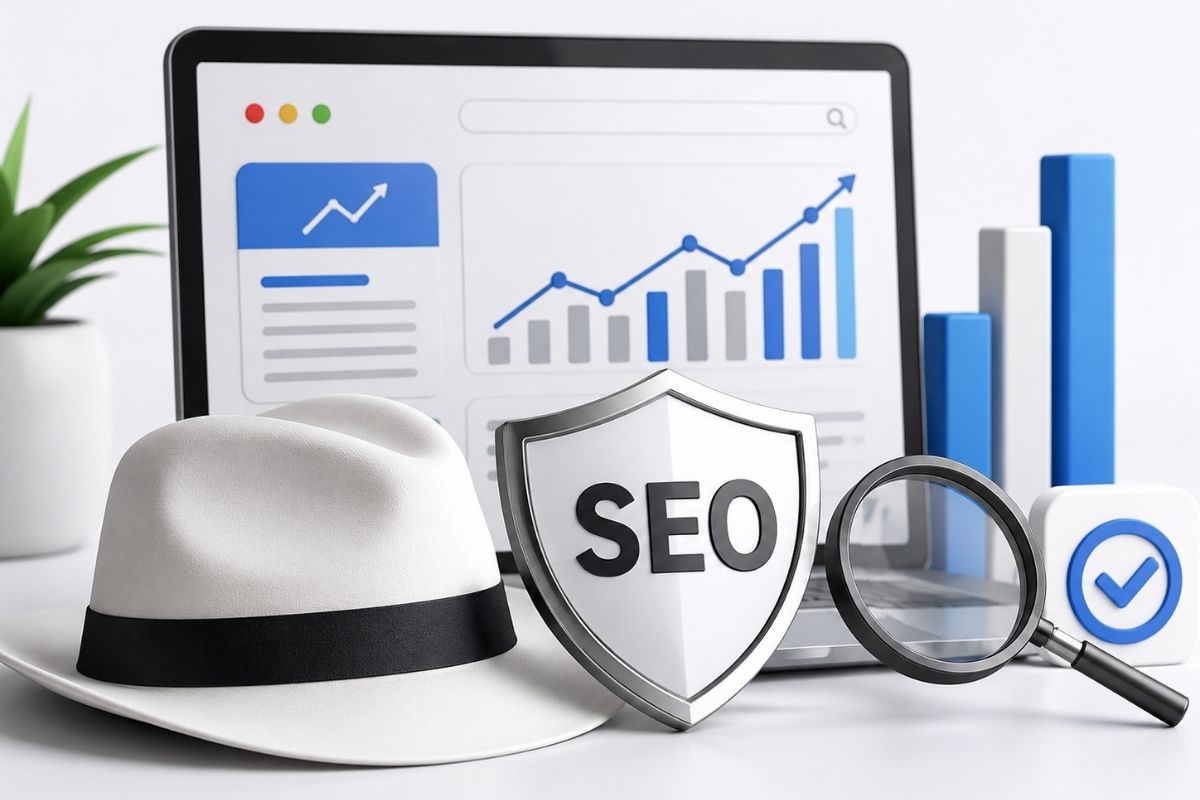
When it comes to search engine optimization, one of the first questions that comes to mind is "what is white hat SEO?" White hat SEO is an optimization approach that strictly adheres to Google's published rules, centers on the user, and aims for long-term sustainable success. So why has this approach become more critical than ever in 2026? Google's AI-powered spam detection systems, Helpful Content updates, and EEAT criteria have made unethical methods almost impossible.
In this article, starting with the definition of white hat SEO, we will explain step by step how to implement it with white hat SEO techniques, the differences between white hat and black hat SEO, and the formula for success in 2026. Whether you are a beginner or an experienced SEO specialist, this guide will provide you with a roadmap to produce content of the quality Google is looking for.
What is White Hat SEO and Why is it So Important?
Definition and Core Philosophy of White Hat SEO
The simplest answer to the question "what is white hat SEO?" is this: it encompasses all optimization methods that fully comply with search engine rules and guidelines, prioritize user experience, and target long-term, sustainable organic growth.
The term "white hat" comes from old Western movies. Good characters wore white hats, while bad characters wore black hats. In the world of SEO, there's a similar distinction: white hats follow the rules, black hats manipulate them.
Google's Search Essentials (formerly Webmaster Guidelines) document defines acceptable SEO as: "Creating helpful, reliable, people-first content, using keywords naturally, and providing real value to searchers."
Core Principles of White Hat SEO
User-centricity: Prioritizing visitor needs, not algorithms
Transparency: All optimization efforts must be open and auditable
Long-term thinking: Aiming for sustainable growth instead of quick wins
Quality first: Investing in content quality, site speed, and user experience
Natural link acquisition: Links are earned, not "forced"
Why is White Hat SEO More Critical in 2026?
As of 2026, white hat SEO has ceased to be a preference and has become a necessity. Here's why:
SpamBrain is constantly working: Google's AI-based spam detection system now operates continuously, rather than through periodic updates. While a black hat tactic used to go unnoticed for months, it can now be detected within hours.
Helpful Content system integrated into core ranking: Google has integrated the Helpful Content system directly into its core ranking algorithm. This means that low-quality or manipulative content is instantly penalized.
Builds trust in the age of AI: AI systems like ChatGPT, Gemini, Claude, and Perplexity look for EEAT (Experience, Expertise, Authoritativeness, Trustworthiness) signals when choosing sources. White hat SEO ensures these systems see you as a reliable source.
Google's spam policies have expanded: In May 2026, Google expanded its spam policies to also cover AI Overviews and AI Mode manipulation. Attempting to manipulate AI summaries is now also penalized.
White Hat vs Black Hat vs Grey Hat SEO
Feature | White Hat SEO | Grey Hat SEO | Black Hat SEO |
|---|---|---|---|
Compliance with Google Rules | ✅ Fully compliant | ⚠️ Grey area, risky | ❌ Full violation |
User Focus | ✅ Priority | ⚠️ Moderate | ❌ Almost non-existent |
Risk Level | Low | Medium - High | Very High |
Time to Results | Medium - Long term | Short - Medium term | Very short term |
Penalty Risk | Very low | High | Very high |
Sustainability | High | Low | Almost non-existent |
Example Tactics | Quality content, natural link acquisition, technical SEO | Link exchanges, PBNs, aggressive guest posting | Keyword stuffing, cloaking, link farms |
Validity in 2026 | ✅ Only valid strategy | ⚠️ Almost completely ineffective | ❌ Immediate penalty risk |
Source:
Important Note: As of 2026, the gap between grey hat SEO and white hat SEO has almost completely closed. Most tactics previously considered "grey area" either no longer work at all or are quickly devalued. It's wise to skip grey hat entirely and focus directly on white hat strategies.
White Hat SEO and Google's Spam Policies
Google's Search Essentials spam policies identify over 16 different categories of prohibited behavior. These policies cover four main areas:
Content manipulation and low-value content: Cloaking, doorway abuse, keyword stuffing, scaled content abuse
Link and reputation manipulation: Link spam, site reputation abuse
Traffic and automation abuse: Machine-generated traffic, user-generated spam
Malicious or deceptive behavior: Malware, deceptive functionality, hidden redirects
Google's approach is clear: "Techniques used to deceive users or manipulate our search systems to rank content highly" are defined as spam.
EEAT: Google's Quality Framework
The 2026 version of Google Search Quality Rater Guidelines centers on the EEAT framework:
Experience: Does the content creator have direct, first-hand experience with the topic?
Expertise: Is the content creator an expert on the subject?
Authoritativeness: Is the content creator or site recognized as an authority in this field?
Trustworthiness: Is the content and site trustworthy?
Google emphasizes that "Trust is the most important member of the EEAT family." A page that is not trustworthy, no matter how experienced or expert it appears, will receive a low EEAT score.
Trends Shaping White Hat SEO in 2026
AI Search: Google's AI Overviews, and systems like ChatGPT and Perplexity, now answer up to 60% of queries without requiring a click. This means your content needs to be optimized not just for clicks, but for direct use as a response.
Information Gain: This Google patent measures how much new information your content adds to existing knowledge. In 2026, content that merely repeats existing information is devalued, while content offering original data and insights stands out.
Entity SEO and Knowledge Graph: Brands and individuals are now recognized as "entities" by search engines. White hat SEO is no longer just about keywords, but also about how your brand entity is represented in the Google Knowledge Graph.
Brand SEO and AEO: Brand awareness and Answer Engine Optimization (AEO) have become integral parts of white hat SEO.
How to Implement White Hat SEO? Step-by-Step Practical Guide
You now know what white hat SEO is and why it has become so critical. So, how are white hat SEO techniques applied in daily SEO work? Here is a step-by-step implementation guide that is valid in 2026 and fully compliant with the rules defined in Google's Search Essentials document.
1. Content Strategy and Helpful Content System
Google's Helpful Content system evaluates whether your content is written for people or for ranking in search engines. In 2026, this distinction has become one of the most critical factors determining rankings.
5 Core Criteria for Helpful Content
Are you fully meeting search intent? If the user is looking for "price," simply describing product features is not enough.
Do you offer original information and analysis? Don't repeat information that can be found on other sites.
Do you cover the topic comprehensively? Don't be superficial, delve deep.
Is it readable and structured? Make the content digestible with headings, lists, and tables.
Is it up-to-date? Especially for rapidly changing topics, date information is crucial.
Google's systems now look at whether the content is created for humans, not whether it was written by AI. So you can use AI, but the resulting text must offer real value to people.
2. Search Intent Analysis
One of the most common mistakes when doing white hat SEO work is ignoring search intent. Google uses advanced AI models to understand the intent behind a query.
Four Core Search Intents
Intent Type | Description | Example Query | Content Type |
|---|---|---|---|
Informational | Wants to gain information | "what is white hat seo" | Guide, definition, explanation |
Navigational | Wants to go to a specific site | "Google Search Central" | Homepage, contact |
Commercial | Researches before buying | "best SEO tool 2026" | Comparison, review |
Transactional | Wants to buy or make a transaction | "buy SEO service" | Product page, quote form |
Aim for each of your pages to serve a single intent. Pages with mixed intents will perform poorly in Google's Helpful Content system.
3. Technical SEO and Core Web Vitals
As a technical SEO consultant, I say: in 2026, white hat SEO is unthinkable without a solid technical infrastructure. Google's Core Web Vitals are measurable indicators of page experience and are direct ranking factors.
2026 Core Web Vitals Thresholds
LCP (Largest Contentful Paint): Under 2.5 seconds
INP (Interaction to Next Paint): Under 200 milliseconds
CLS (Cumulative Layout Shift): Under 0.1
Striking Data: In 2026, only 34% of sites meet all three thresholds. Sites that pass these thresholds gain a significant competitive advantage. In fact, speed improvements have been shown to increase revenue per visitor by up to 53%.
Technical SEO Checklist
□ Mobile-friendliness (responsive design)
□ HTTPS and secure certificate
□ XML sitemap
□ Correct robots.txt configuration
□ Broken links (404) check
□ Cleaning up redirect chains
□ Schema markup (structured data)
□ Page speed optimization (image compression, caching, CDN)
4. On-Page SEO Optimization
The most fundamental of white hat SEO techniques is optimizing each page independently. As emphasized in Google's SEO Starter Guide, sites compliant with Search Essentials increase their chances of appearing on Google.
Title Tag
Should be between 50-60 characters
Focus keyword should be at the beginning
Should be unique for each page
Should encourage users to click
Meta Description
Between 155-160 characters
Focus keyword should appear naturally
Should contain a clear call to action (CTA)
Should accurately reflect page content
Heading Hierarchy (h1-H6)
There should be only one h1 on the page
h2s should represent main topic headings, h3s subheadings
Headings should reflect the logical flow of the content
Keywords should appear naturally in headings
Image Optimization
Alt text (alternative text) should be descriptive for each image
File names should be meaningful and separated by hyphens
Image sizes should be optimized (WebP format preferred)
Images should not negatively impact page speed
5. White Hat Link Building
Links are still an important ranking signal for Google. But in 2026, the approach has fundamentally changed: link earning is now much more valuable than link building.
White Hat Link Strategies Working in 2026
1. Original Research and Data-Driven Content
Surveys, data analyses, and research you conduct in your own industry naturally attract backlinks. Other sites will want to reference your data.
2. Digital PR and Expert Commentary
Providing expert commentary on topics in your industry allows you to be featured in authoritative publications. This is effective for both brand awareness and quality backlinks.
3. Guest Posting
Guest posting on reputable, relevant sites increases your authority. However, avoid low-quality or spammy sites.
4. Brand Mention Acquisition
Identifying sites that mention your brand but don't link to you and requesting a link is a white hat method.
5. Getting Links from Partners and Suppliers
Sharing reciprocal links with your business partners and suppliers is a natural and ethical method.
Important: Google's link spam detection has significantly improved in 2026. While low-quality links may no longer penalize you, they are worthless and a waste of time.
6. Strengthening EEAT Signals
Google Search Quality Rater Guidelines evaluate content quality within the EEAT framework. Google's own guidelines explicitly state: "Untrustworthy pages will receive low EEAT scores, no matter how experienced or expert they appear."
Practical Ways to Strengthen EEAT
Experience
Share your first-hand experiences in the content
Include real-world use cases and case studies
Use evidentiary visuals such as photos and videos
Expertise
Clearly state areas of expertise in author biographies
Provide academic or industry references
Share certifications or training related to the topic
Authoritativeness
Show references from other authorities in the industry
Link to authoritative sources
Ensure your brand is defined in the Knowledge Graph
Trustworthiness
Share your contact information openly
Include a privacy policy and terms of use
Show user reviews and testimonials
7. Information Gain
Google's 2022 patent, "Contextual Estimation of Link Information Gain," ushered in a new era in the SEO world. The essence of this patent is: If your content merely repeats information already found in the top 10 results for the same topic, your Information Gain score is zero.
How to Achieve Information Gain?
Analyze competitor content: Identify points that the content on the first page missed
Add original data: Share your own research, surveys, or case studies
Offer a different perspective: Approach the topic from an unconventional angle
Use up-to-date information: Instead of repeating old information, add the latest developments
Conduct in-depth analysis: Explain cause-and-effect relationships instead of superficial information
Warning: The "skyscraper strategy" (collecting the top 10 results and creating longer content) no longer works. Google rewards original content, not just long content.
8. White Hat SEO in the Age of Artificial Intelligence
In 2026, SEO is no longer just for Google; it now requires optimization for AI systems like ChatGPT, Gemini, Claude, and Perplexity.
Optimization for AI Systems
Structured data (Schema): Makes it easier for AI systems to understand your content
Clear and concise answers: Short, clear answers that AI can directly quote
Entity connections: Your brand and individual entities defined in the Knowledge Graph
Source credibility: AI's marking you as a reliable source
Google's May 2026 expansion of its spam policy now includes AI Overviews and AI Mode manipulation. This means that attempting to manipulate AI responses is also now penalized.
The Future of White Hat SEO, Advantages, and 2026 Strategies
We've extensively covered what white hat SEO is, how it's implemented, and its core techniques. Now, let's look at the advantages of the white hat SEO approach, the challenges you might face, and how to take this strategy to the next level in 2026. The interesting part is that white hat SEO has become a necessity not only for Google but also for AI-powered search systems.
Advantages and Disadvantages of White Hat SEO
Like any strategy, white hat SEO has its strengths and weaknesses. However, as of 2026, the advantages far outweigh the disadvantages to such an extent that there is almost no alternative.
Advantages
1. Sustainable and Lasting Results
The rankings you gain with white hat SEO are minimally affected by algorithm updates. With Google's helpful content system integrated into core ranking, sites producing quality content are positively impacted by updates, while those producing low-quality content are penalized.
2. Almost Zero Risk of Penalty
As long as you don't violate Google's 16+ spam policies, your risk of a manual penalty or algorithmic drop is almost non-existent. In 2026, SpamBrain is constantly working, and black hat tactics are almost instantly detected.
3. Builds Brand Authority and Trust
Sites that generate strong signals within the EEAT framework are identified as trusted sources by both Google and AI systems. As Google emphasizes in its Search Quality Rater Guidelines, trustworthiness is the most important element of EEAT.
4. Provides Visibility in AI Systems
Systems like ChatGPT, Gemini, Claude, and Perplexity look at EEAT signals and structured data when choosing sources. White hat SEO ensures these systems see you as a reliable source.
5. Long-Term Organic Traffic Growth
Instead of short-term boosts, it provides a stable and continuously increasing flow of organic traffic. This means predictable growth for businesses.
Disadvantages
1. Results Take Time
White hat SEO does not promise quick wins. Initial signals are usually observed within 3-6 months, with significant improvements seen in 6-12 months.
2. Requires Continuous Effort
It's not a one-time effort but a process requiring continuous maintenance and improvement. Content creation, technical optimization, and link acquisition are never-ending tasks.
3. Intense Competition
Especially in popular industries, competing with rivals practicing white hat SEO is challenging. Differentiation and providing information gain are essential.
4. Can Be Resource-Intensive
It requires quality content production, investment in technical infrastructure, and expert personnel. For small businesses, this can be a cost.
So why white hat still? Because in 2026, there is no alternative. The gap between grey hat and white hat has almost completely closed. Old grey hat tactics either no longer work at all or are devalued without being noticed.
Why Google Values White Hat SEO?
Google's mission is to organize the world's information and make it universally accessible and useful. The natural consequence of this mission is that Google wants to provide its users with the highest quality, most reliable, and most useful results.
Google's Perspective
As explicitly stated in the Google Search Essentials document: "Sites that focus on offering the best content and experience for users and uphold the spirit of our principles are more likely to succeed in Google Search results."
Google's spam policies cover all behaviors aimed at deceiving users or manipulating search systems. In 2026, these policies were expanded to include AI Overviews and AI Mode manipulation.
Role of Algorithms
Google's algorithms are designed to reward white hat SEO:
Helpful Content System: Evaluates whether content is written for people or for ranking
SpamBrain: Continuously running AI-based spam detection system
EEAT Framework: Evaluates content quality in terms of experience, expertise, authoritativeness, and trustworthiness
Google's Recommended Practices and Things to Avoid
Google's Recommended Practices ✅ | Things to Avoid ❌ |
|---|---|
Creating helpful, reliable content for users | Keyword stuffing |
Natural and organic link acquisition | Link farms and paid link schemes |
Transparent and understandable site structure | Cloaking and deceptive redirects |
Mobile-friendly and fast site experience | Hacked content and malware |
Using structured data (Schema) | Scaled content abuse (mass AI content) |
Producing quality content with expert writers | Site reputation abuse ("parasite SEO") |
Valuing user feedback | Hidden text and image manipulation |
Strengthening EEAT signals | Expired domain manipulation |
Source: Google Search Essentials Spam Policies
2026 Algorithms and White Hat SEO
2026 was a transformative year for the SEO world. Here are key developments directly impacting white hat SEO:
Integration of Helpful Content System into Core Ranking
With the Core Update in December 2025, the Helpful Content system was directly integrated into the core ranking algorithm. There is no longer a separate "Helpful Content Update"; quality assessment is continuous. This means that content quality is evaluated instantaneously, and low-quality content is quickly penalized.
New Spam Policies
With the December 2025 update, three new spam policies came into effect:
Expired domain manipulation
Scaled content abuse (including mass AI-generated content)
Site reputation abuse ("parasite SEO")
Increased Weight of Core Web Vitals
The March 2026 Google core update increased the weight of Core Web Vitals in the ranking algorithm. Sites passing the thresholds climbed in rankings, while those that didn't experienced a decline.
EEAT Extended to All Categories
The December 2025 core update expanded EEAT requirements beyond YMYL (Your Money, Your Life) topics to cover all competitive categories.
Entity SEO, Knowledge Graph, and Brand Visibility
In 2026, entity optimization holds a critical place among white hat SEO techniques. Google's Knowledge Graph contains information about more than 800 billion entities. This fundamentally changes how search engines and AI systems understand content.
What is Entity SEO?
Entity SEO is the practice of making your brand, products, and industry-related concepts a clear, connected, and verifiable entity in Google's Knowledge Graph.
Why is it Important?
AI systems cannot confidently cite a source if they cannot distinguish one entity from another
The Knowledge Graph is the fundamental data layer that AI systems refer to
Entity optimization determines whether you appear in AI searches
Brand SEO
White hat SEO is now concerned not only with keywords but also with how your brand entity is perceived:
Consistent third-party verifications: Other authoritative sites mentioning you builds trust
Knowledge Graph Entity Score: A score from 0-100 indicating how completely your organizational or local business entity is defined
Entity connections: Linking your brand to related concepts, people, and organizations
AEO and GEO: Next-Generation Optimization
In 2026, white hat SEO extends beyond traditional search engines to include AI-powered answer engines.
Answer Engine Optimization (AEO)
AEO optimizes your content to be used as a direct answer. The goal is for an AI system to cite you as a source when directly answering a question.
Generative Engine Optimization (GEO)
GEO shapes how AI systems represent your brand. Not only the quoted line, but also the comparisons, recommendations, and reasoning of the systems are important.
Striking Data: In January 2026, "Generative Engine Optimization" searches reached 54.3K, while "Answer Engine Optimization" searches remained at 30K. GEO has surpassed AEO.
Practical Steps for AEO/GEO
Use structured data (Schema): Makes it easier for AI systems to understand your content
Create an llms.txt file: Tell AI systems how to consume your content
Don't block bot access: Allow AI bots to crawl your content
Increase fact density: Use concrete data, statistics, and evidence
Provide direct answers: Prepare short, clear, and concise answers
Google's first official AI optimization guide emphasizes that AEO and GEO are still SEO, and the fundamental principles haven't changed.
Common Mistakes and Misconceptions in White Hat SEO
Common Mistakes
1. Writing content "for SEO"
The Helpful Content system instantly detects whether content is written for people or for ranking. Your focus should always be on the user.
2. Getting hung up on keyword density
In 2026, keyword density has become almost irrelevant. What matters is covering the topic comprehensively and meaningfully.
3. Repeating old information
Lack of Information Gain causes your content to be devalued. Google rewards content that adds new information to existing knowledge.
4. Buying links
Google's link spam detection greatly improved in 2026. Purchased links are either worthless or lead to penalties.
5. Neglecting technical SEO
Core Web Vitals are now a direct ranking factor. Content quality alone is not enough without a solid technical infrastructure.
Misconceptions
Mistake: "Longer content is always better"
Truth: Not length, but information gain and meeting user intent are important. Unnecessarily long content is penalized by the Helpful Content system.
Mistake: "AI-generated content gets penalized"
Truth: Google looks at how much value the content offers to the user, not how it was produced. AI content should be reviewed by a human editor and contain original data.
Mistake: "Grey hat SEO still works"
Truth: In 2026, the gap between grey hat and white hat has almost completely closed. Old grey hat tactics either no longer work at all or are devalued without being noticed.
Mistake: "Backlinks are no longer important"
Truth: Backlinks are still an important ranking signal. However, quality, not quantity, is what matters. A few high-quality, authoritative links are more valuable than hundreds of low-quality ones.
White Hat SEO for Organic Growth and Sustainability
The greatest strength of white hat SEO is its ability to provide sustainable organic growth. This is not a "hack," but a business strategy.
How to Achieve Organic Growth?
Content depth and breadth: Content that covers the topic comprehensively and details all subheadings
Regular updates: Keeping old content up-to-date preserves Information Gain
User signals: Low bounce rate, high engagement time
Brand mentions: Other sites mentioning you increases authority
Entity expansion: Your brand having increasingly more connections in the Knowledge Graph
5 Principles of Sustainable SEO
User comes first: The user is at the center of every decision
Quality over quantity: Less but essential is better than much but superficial
Aim for the long term: Don't fall into the trap of quick gains
Be transparent: All your optimization efforts should be open and auditable
Continuously learn: SEO is dynamic,
Frequently asked questions
What is Grey Hat SEO, can you briefly define it?+
Grey Hat SEO refers to SEO methods that fall between white hat (ethical) and black hat (rule-breaking), which are not directly against Google's guidelines but have the intention of manipulating rankings. For example, scaled guest posting or PBN networks.
Does Grey Hat SEO result in a Google penalty?+
Yes, it does. While not technically "forbidden," Google's SpamBrain AI detects manipulation patterns. This can lead to algorithmic suppression or manual penalties. In 2026, this risk has increased even further.
What is the biggest difference between Grey Hat SEO and White Hat SEO?+
White Hat SEO targets user experience and long-term value; Grey Hat SEO aims to gain quick rankings by exploiting loopholes in Google's rules. White Hat is permanent, Grey Hat is temporary and risky.
Which Grey Hat SEO techniques are the riskiest in 2026?+
The use of PBNs (private blog networks), scaled AI content generation, expired domain redirects, and undeclared paid links are in the highest risk group. Google easily detects these methods.
How do you clean a site from Grey Hat SEO techniques?+
You need to disavow all suspicious backlinks, remove or improve low-quality content, dismantle artificial link networks, and submit a reconsideration request to Google. However, this process can take months and success is not guaranteed.
Sources

Recep Bayoğlu
SEO Team Leader
If you want to talk more about this topic or need a tailored solution for your brand, you can reach me directly.
Our Services
Related Services
Google Ads Management
Top pickUse your ad budget most efficiently with professional Google Ads management.
Meta (Facebook & Instagram)
Reach your target audience with Facebook and Instagram ads.
SEO Consulting
Rank higher in search engines and grow organic traffic.
GEO Consulting
Get cited as a source inside ChatGPT, Gemini and Perplexity answers.
Social Media Management
Strengthen your online presence with professional social media management.
E-Commerce Solutions
T-Soft, İkas, Ticimax and İdeasoft infrastructures.
TikTok Ads
Reach young audiences with TikTok ads.
Video Production
Professional 4K video production services.
Web Design
Modern user-friendly web design.
Yandex Ads Management
Reach Russian and CIS markets with Yandex ads.
Telegram Ads Management
Reach audiences directly with Telegram sponsored messages.
ChatGPT Ads Consulting
Position your brand in the in-chat advertising ecosystem.
Gemini Ads Consulting
Gain an early advantage in Google AI Mode ads.
T-Soft E-Commerce Site
T-Soft infrastructure for enterprise scale.
İdeasoft E-Commerce Site
Flexible and powerful e-commerce infrastructure.
İkas E-Commerce Site
Fast setup, modern e-commerce infrastructure.
Ticimax E-Commerce Site
Scalable e-commerce solution.
More from this category

digitalup What Are SEO Services? What Does Search Engine Optimization (SEO) Service Cover?
digitalup What is a Knowledge Graph?

digitalup Can SEO Be Done With Artificial Intelligence? (Step-by-Step AI SEO Guide)