You run ads, allocate budget, prepare visuals… But sales aren't coming in. Does this sound familiar?
Most business owners and marketers spend money on Facebook and Instagram ads often shooting blindly. They don't see the target, they just pull the trigger. Yet, the golden rule of digital advertising is simple: Deliver the right message to the right person at the right time.
This is precisely where the process of audience targeting in Facebook and Instagram ads comes into play. In this article, I will share actionable strategies aligned with the Meta algorithm that will help you get much more for your ad budget.
What is an Audience and Its Critical Role in Ad Success
An audience is a group of people most likely to be interested in your product or service. But this definition is much deeper than you might think.
Why is Audience Definition a Must-Have?
Meta has incredibly detailed data about its users. From basic demographic information like age, gender, and location, to which pages users interacted with in the last 30 days, which car they admired, or even if they recently got married… When used correctly, this data can reduce your ad costs and increase your conversion rates.
Imagine, you run a boutique coffee shop in Ankara and you're showing ads to coffee lovers living in Istanbul. Does that make sense? Of course not. Defining your audience is precisely about preventing this waste.
Audience Types in Meta Ads: What Each One Does
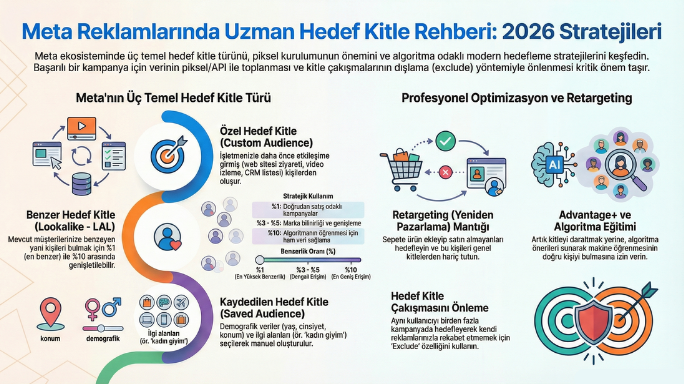
In Facebook and Instagram Ad Manager, you'll encounter three core audience types. Each one is used for different purposes.
1. Core Audiences
Audiences you manually create in Ad Manager, based on demographics and interests.
Use case: New product launches, brand awareness campaigns, reaching a broad audience.
Example: Women aged 25-40, living in Istanbul, interested in yoga.
2. Custom Audiences
Audiences created from people who have already interacted with your business. This is gold!
Sources:
-
Website visitors (thanks to Meta pixel)
-
Customer lists (with email or phone numbers)
-
People who interacted with your Instagram or Facebook page
-
Video viewers
-
Lead form completers
Example: People who added items to their cart on your website but didn't complete the purchase in the last 30 days.
3. Lookalike Audiences
Audiences that help you find new potential customers who resemble your existing customers. Meta's AI analyzes the characteristics of your best customers and finds new people who are similar to them.
Use case: Scaling, expanding into new markets, growing your customer base.
Example: A 1% lookalike audience based on your existing loyal customers.
Audience Creation in Facebook and Instagram Ads: Step-by-Step Strategies
Now it's time to move from theory to practice. By implementing the strategies below, you can multiply your ad performance.
Demographic Targeting: Build a Strong Foundation
Age, gender, location are the most basic parameters. But be careful!
Location targeting tip: If you have a physical store, target people within a 5-10 km radius of your store. If you do e-commerce, select the regions you can ship to.
Age range: Analyze the actual user age of your product. Choosing very broad ranges like "18-65" confuses the algorithm.
Interest Targeting: Gold Hidden in Details
Meta identifies thousands of interests based on pages users like, accounts they follow, and ads they click.
Three layers in interest targeting:
-
Competitor brands: Target those who like your competitor's page.
-
Complementary products: If you sell baby diapers, target baby food brands.
-
Lifestyle: If you're a travel agency, use interests like "flight tickets", "hotel reservations", "holiday".
Behavioral Targeting: Capture Consumer Habits
Meta also tracks users' online and offline behaviors.
-
Those who recently moved
-
Those with upcoming birthdays
-
Those with anniversaries
-
Those prone to online shopping
Example scenario: If you run a furniture store, the "recently moved" filter is invaluable.
Real-Life Ad Scenarios: Small Business vs. E-commerce
Scenario 1: Boutique Coffee Shop (Small Business)
Goal: Attract customers to a newly opened branch.
Audience strategy:
-
Location: 3 km radius of the new branch
-
Age: 25-45
-
Interests: Starbucks, coffee, breakfast spots, brunch
-
Custom audience: Those who interacted with your Instagram posts
-
Lookalike audience: 1% lookalike audience created from existing customer emails
Scenario 2: Online Sports Apparel Store (E-commerce)
Goal: Sales of the new season collection.
Audience strategy:
-
Location: All of Turkey (where shipping is available)
-
Age: 18-45
-
Gender: Female (if the product is a women's collection)
-
Interests: Nike women, Adidas women, fitness, pilates, yoga
-
Custom audience: Those who visited the site in the last 30 days but didn't purchase (retargeting)
-
Lookalike audience: 1-3% lookalike audience created from highest spending customers
Common Audience Targeting Mistakes
Knowing the pitfalls advertisers often fall into will save you from significant budget losses.
Mistake 1: Too Narrow Targeting
Creating an audience of 3000 people and expecting the algorithm to work miracles… It won't happened. Meta's AI needs sufficient data to learn. General rule: Your target audience should be at least 50,000-100,000 people.
Mistake 2: Too Broad Targeting
Saying "everyone aged 18-65 living in Turkey" effectively means "whoever finds me can buy." In this case, your ad will be shown to irrelevant people, your click-through rates will drop, and your costs will increase.
Mistake 3: Overlapping Interests
You should add "yoga" AND "pilates" interests as OR, not AND. Otherwise, your audience will be unnecessarily narrow.
Mistake 4: Not Installing the Pixel Correctly
If your Pixel isn't working properly, you can't create custom audiences. You can't track conversions. This means you're trying to fly a plane without knowing how to use it.
Audience Strategies for the 2026 Meta Algorithm
Meta's algorithm is constantly changing. With iOS 14 updates, privacy policies, etc., detailed targeting has become more difficult than before. So, what should you do?
Era of Broad Targeting + Creative Content
Meta now looks at the performance of creative content more than the targeting you do. This means the better your ad copy, visual, or video, the better the algorithm finds the right people.
Recommendation: Use broad targeting (only age and location), but diversify your ad content based on different people who might be interested in the product.
AI-Powered Targeting (Advantage+)
Meta's Advantage+ targeting feature can perform better than your manual targeting. The system automatically finds people with high conversion potential.
Advice: Compare manual targeting with Advantage+. Choose whichever brings you conversions at a lower cost.
Creating Custom Audiences from Video Viewers
Video content is an excellent tool for measuring user interest.
-
Those who watched 25% of the video (superficial interest)
-
Those who watched 50% of the video (medium interest)
-
Those who watched 75-100% of the video (high interest)
Prepare special campaigns for these segments. Sending a discount code to those who watch the video to the end is a great tactic.
Professional Tips: Tactics to Multiply Your Ad Performance
1. A/B Testing is a Must
Don't get stuck with a single target audience. Create at least 3-5 different target audiences, show the same ad to each, and see which one performs better.
Audiences to test:
-
Interest-based audience
-
Competitor brand-based audience
-
Lookalike audience (1%, 2%, 3%)
-
Website visitors (retargeting)
2. Hot, Warm, Cold Audience Segmentation
Determine your ad strategy based on the "warmth" of the audience:
-
Cold audience: Those who have never heard of your brand → Brand awareness, attention-grabbing content
-
Warm audience: Those who visited your website, watched videos → Product benefits, customer reviews
-
Hot audience: Those who added products to cart but didn't buy, former customers → Discount codes, limited-time campaigns
3. Control Frequency
How many times you show the ad to the same person is very important. When the frequency exceeds 3-4, ad fatigue sets in. Click-through rates drop, and costs increase.
Solution: Regularly check your ad sets, refresh creatives, or expand the audience.
4. Seasonal and Period-Based Targeting
Change your targeting strategy during special days like New Year's, Mother's Day, Valentine's Day.
Example: On Mother's Day, target people interested in keywords like "gift", "flowers", "necklace", "mom".
Frequently Asked Questions About Audience Creation
Can I use the same target audience on Facebook and Instagram?
Yes, Meta's ad manager covers both platforms. However, user behavior differs on each platform. Instagram has a younger, visually-oriented audience, while Facebook appeals to a broader age range. Optimize your ad formats for each platform.
What should be the percentage of the lookalike audience?
A 1% lookalike audience contains the most similar people, but if your audience is small, 2-3% might yield better results. For starters, test 1%, 2%, and 3% to see which brings conversions at a lower cost.
Should my target audience be large or small?
It depends on your daily budget. Advertising to an audience of 1 million with a 100 TL budget is meaningless. A basic rule: Target an audience at least 10 times the size of your daily budget. So, if you have a 100 TL budget, target at least 1000 people, but the ideal is 50,000+ people.
Can I create a target audience if I don't have a Pixel?
Yes, you can do basic demographic and interest targeting. However, the Pixel is essential for retargeting and creating lookalike audiences. I strongly recommend installing the Pixel.
Practical Application: 3 Actions You Can Start Today
-
Check your Pixel: Is it active? Is it working correctly? Check it right now from Meta Business Suite.
-
Upload your customer list: If you have email or phone numbers, upload them to Meta and create a custom audience.
-
Launch an A/B test: Define two different target audiences, show the same ad to each with a 50 TL budget. After 3 days, compare which performed better.
Remember: The Target Audience is Dynamic
It is not a static structure. A strategy that works today might not work in 3 months. The market changes, consumer behaviors change, Meta's algorithm updates. That's why you should regularly review, refresh, and test your target audiences.
The process of creating target audiences in Facebook and Instagram ads requires patience and trial and error. But when done correctly, you will multiply the return on your ad budget.
Now it's your turn. Open your ad manager immediately and start applying what you've learned in this article. When you see the initial results, you'll say, "where has this been all this time?"
Frequently asked questions
What is the cost of creating an audience for Facebook ads?+
Creating an audience itself is free. You only allocate a budget when running ads. The more detailed and accurate your targeting, the lower your ad costs will be.
Is creating an audience on Instagram different from Facebook?+
Technically, there's no difference because you use the same ad manager. However, Instagram users are generally younger and more responsive to visual content. Therefore, you should make your interest selections accordingly.
What is remarketing (retargeting)?+
It is showing ads again to people who have visited your website or used your application. For example, you can show a reminder ad to people who added products to their shopping cart but did not make a purchase.
How many customers are needed to create a lookalike audience?+
Your source audience must contain at least 100 people. However, for better results, 1000+ people are recommended. The more data, the better the match.
How often should I update my audience?+
Review your target audiences at least once a month. Your custom audiences (such as website visitors) are updated automatically. It is beneficial to recreate your lookalike audiences every 2-3 months.
Sources

Ayşenur Yılmaz
Google & Meta Ads Team Leader
If you want to talk more about this topic or need a tailored solution for your brand, you can reach me directly.
Our Services
Related Services
Google Ads Management
Top pickUse your ad budget most efficiently with professional Google Ads management.
Meta (Facebook & Instagram)
Reach your target audience with Facebook and Instagram ads.
SEO Consulting
Rank higher in search engines and grow organic traffic.
GEO Consulting
Get cited as a source inside ChatGPT, Gemini and Perplexity answers.
Social Media Management
Strengthen your online presence with professional social media management.
E-Commerce Solutions
T-Soft, İkas, Ticimax and İdeasoft infrastructures.
TikTok Ads
Reach young audiences with TikTok ads.
Video Production
Professional 4K video production services.
Web Design
Modern user-friendly web design.
Yandex Ads Management
Reach Russian and CIS markets with Yandex ads.
Telegram Ads Management
Reach audiences directly with Telegram sponsored messages.
ChatGPT Ads Consulting
Position your brand in the in-chat advertising ecosystem.
Gemini Ads Consulting
Gain an early advantage in Google AI Mode ads.
T-Soft E-Commerce Site
T-Soft infrastructure for enterprise scale.
İdeasoft E-Commerce Site
Flexible and powerful e-commerce infrastructure.
İkas E-Commerce Site
Fast setup, modern e-commerce infrastructure.
Ticimax E-Commerce Site
Scalable e-commerce solution.